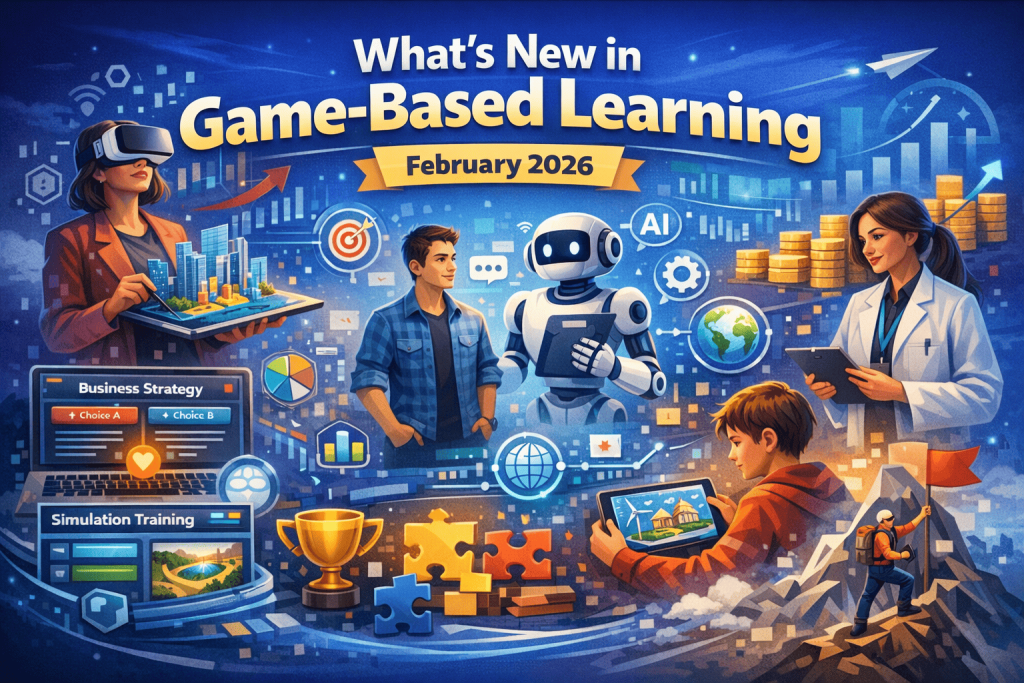
The early months of 2026 have proven that game based learning is no longer just a trend—it is a cornerstone of effective instructional design. As we move through February, the conversation has shifted from “Can games teach?” to “How can we make game-based outcomes more observable and scalable?”
For organizations looking to lead, understanding the latest developments in game-based learning in 2026 is essential. This month, we are seeing a focus on functional design, emotional resonance, and the technical infrastructure that allows for seamless integration.
1. Functional Design: Making Thinking Visible
One of the standout developments in February 2026 is the shift toward “function over novelty.” Modern game based learning is being used in sectors where judgment and decision-making are difficult to “fake.”
Recent implementation patterns show games being used for:
- Executive Decision-Making: High-level simulations that blend physical board game elements with digital tracking to test risk tolerance and long-term planning.
- Climate and Policy Planning: “Serious games” that allow policy makers to navigate the uncertainty of climate adaptation, moving beyond linear planning to systems thinking.
- Higher Education: New research has solidified the link between video gaming and the development of transferable skills like strategic thinking and time management, leading more universities to adopt best game based learning platforms as core curriculum components.
2. Gamification 2.0: Moving Beyond the “Holy Trinity”
For years, gamification relied heavily on the “Holy Trinity” of points, badges, and leaderboards. In 2026, these are considered “surface-level” mechanics. The latest game based learning strategy focuses on Emotional Design and Narrative Anchoring.
Narrative Anchoring with Character Arcs
Instead of just earning a badge, learners now inhabit roles—such as a “Safety Investigator” or “Financial Analyst.” The role itself becomes the reward. By following a character arc, the learner experience becomes fluid and immersive, significantly increasing curiosity and completion rates.
Micro Missions
Long, arduous tasks are being replaced by “Micro Missions.” These are 3–7 minute bursts of activity—like “fix the process deviation”—that add up to a larger sense of mastery. This aligns with the 2026 trend of mobile-first, just-in-time learning.
3. The Power of AI-Powered Personalized Challenge Routes
Artificial Intelligence has revolutionized how we scale game based learning. In February 2026, we are seeing the widespread adoption of Neuro-Adaptive Feedback Loops.
Through machine learning, platforms can now adjust the difficulty of a game in real-time based on the learner’s emotional state (detected via Emotion AI) and performance data. If a learner is frustrated, the game provides an “adaptive bridge” to help them succeed. Conversely, if they are breezing through, the system injects complexity to keep them in the “flow state.”
4. Technical Breakthroughs: 5G and Edge Streaming
The barrier of “hardware requirements” has finally crumbled. With the expansion of 5G grids in 2026, cloud-rendered AR and VR simulations are now streaming seamlessly to mid-tier mobile devices.
This has opened the door for best game based learning platforms to offer:
- Cloud-Based VR: High-fidelity training without the need for expensive local processing power.
- Location-Based Games: Using 5G and GPS to trigger learning missions based on a worker’s physical location (e.g., a safety drill that activates when an engineer enters a specific zone).
Game-Based Learning Market Snapshot (February 2026)
The growth of this sector is staggering. As L&D budgets move toward high-impact engagement, the following statistics highlight the current state of the market:
| Metric | 2026 Projection |
| Market Valuation | USD 34.90 Billion |
| Engagement Increase | Up to 150% compared to traditional e-learning |
| Completion Rates | 48% higher in gamified corporate programs |
| Target Attainment | Sales teams using games hit targets 78% faster |
5. Why Strategy Precedes Technology
While the tech is exciting, the most successful implementations this month share a common thread: a robust game based learning strategy.
Dynamic Pixel has observed that the most effective games are those built on a foundation of Instructional Design. It is not about the “bells and whistles”—it’s about the feedback loops. A well-designed game provides immediate, non-punitive feedback that allows a learner to try, fail, and iterate until mastery is achieved.
Key Strategy Components for 2026:
- Real-World Tie-In: Scenarios must mimic real-world problems (e.g., a compliance game that uses actual fraud patterns from the previous quarter).
- Social Gamification: Moving away from isolated play toward “Community Missions” where team collaboration is required to unlock the next level.
- Stackable Credentials: Using blockchain-powered badges that act as “micro-credentials” for hiring and promotion decisions.
Conclusion: The Path Forward
As we move further into 2026, game based learning is proving to be the ultimate tool for behavioral change. By combining the emotional power of storytelling with the precision of AI and the accessibility of 5G, organizations can create training that employees actually want to finish.
Whether you are looking for best game based learning platforms or starting from scratch with a custom game based learning project, the focus must remain on the learner’s journey.
Dynamic Pixel is helping organizations turn flat content into “alive” experiences. By focusing on emotional design and adaptive intelligence, we ensure that your learning strategy isn’t just a game—it’s a competitive advantage.