Introduction
Online learning has become a part of our everyday lives. Whether you’re a student wanting to learn coding, a professional upgrading your skills, or someone curious about a new subject, chances are you’ve considered taking a course online.
But here’s the thing—many people still aren’t sure what online learning actually is. They confuse it with self-study. Some think it means watching random YouTube videos. Others believe it’s just recorded lectures without any real interaction.
The truth? Online learning is much broader and more structured than that.
In this guide, we’ll break down what online learning really means, how it works in practice, and why it’s becoming the preferred way to learn for millions of people worldwide. By the end, you’ll understand not just the definition, but also how you can use it to achieve your goals.
What Is Online Learning? The Real Definition
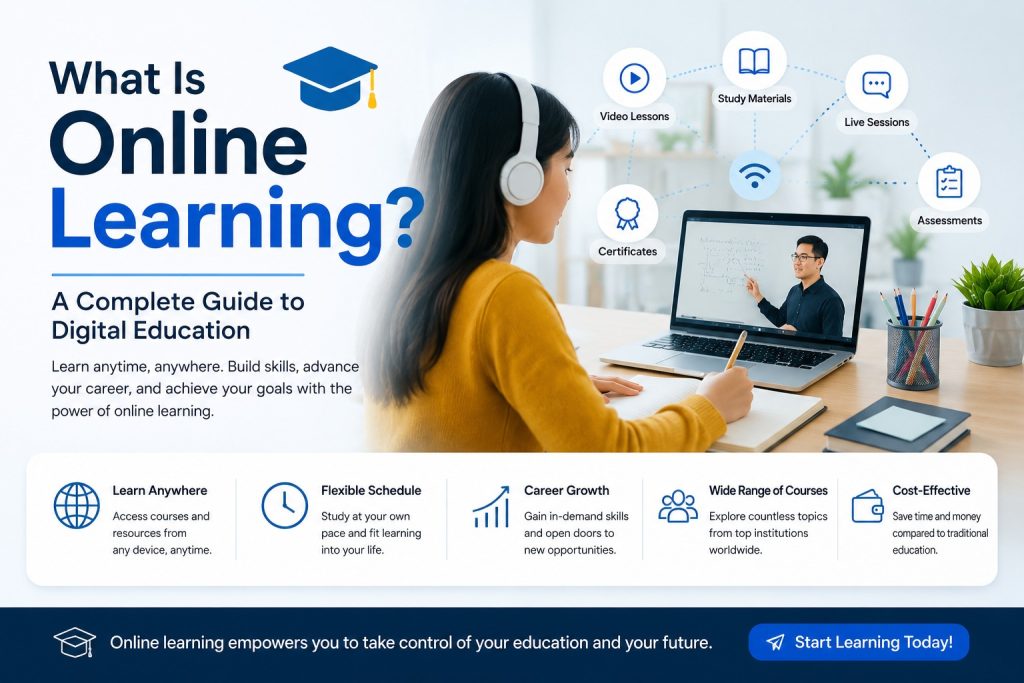
Online learning is the process of acquiring knowledge and skills through the internet using digital devices. It’s education delivered through computers, tablets, or smartphones instead of traditional classrooms.
But it goes beyond that simple explanation. Online learning can be:
- Live classes where you interact with instructors in real-time through video calls
- Pre-recorded courses that you watch at your own pace
- Self-paced modules with quizzes and assignments
- Interactive platforms with discussions and peer learning
The core idea is that you’re not sitting in a physical classroom with a teacher standing in front of you. Instead, you’re learning through digital platforms, at your own speed, from wherever you want.
Think of it like this: Instead of going to a coaching center in your city, you can attend classes from your home, your office, or even a café. The teacher might be in a different city or country, but you’re still getting quality education.
How Is Online Learning Different From Traditional Classroom Learning?
Let me be honest—there are clear differences between online learning and traditional education:
Flexibility and Schedule
In a traditional classroom, you go to class at fixed times. If you’re working or have other commitments, it becomes difficult.
With online learning, you decide when to study. You can watch a lecture at 6 AM or 11 PM. You can study for 30 minutes or 3 hours—whatever fits your life.
Location Independence
You don’t need to travel to a physical location. This is huge for people in smaller cities where quality coaching might not be available.
A student in Ludhiana can take classes from instructors in Mumbai or even internationally. This opens up opportunities that weren’t possible before.
Cost Effectiveness
Online courses are usually cheaper than traditional coaching classes or college courses. You save on travel, accommodation, and infrastructure costs. Institutions also save money by not maintaining physical buildings, and they pass those savings to students.
Interaction Style
In a classroom, you raise your hand to ask a question. Online, you can ask questions in chat, discussion forums, or emails. Some people feel more comfortable with this. Others miss face-to-face interaction.
Pace of Learning
In a classroom, the teacher teaches at one speed. Everyone has to keep up.
Online platforms let you rewind lectures, watch them again, and take time to understand topics. If you’re fast, you move ahead. If you need more time, you take it.
Types of Online Learning Explained
Online learning definition isn’t one-size-fits-all. There are different models:
1. Self-Paced Learning
You get access to course materials, videos, and assignments. You complete everything on your own schedule, with no live classes.
Best for: Busy professionals, people with unpredictable schedules, or those who learn better alone.
Examples: Many coding courses, language learning apps, and hobby-based courses.
2. Live Online Classes
This is like a traditional classroom, but online. The instructor teaches at a fixed time, and students join through video conferencing.
Best for: People who like structure, need real-time interaction, and want to ask questions immediately.
Examples: Most MBA programs, competitive exam coaching, and professional certification courses.
3. Hybrid Learning
A mix of both. Some classes are live, others are recorded. Some discussions happen in real-time, others asynchronously.
Best for: Those who want flexibility but also appreciate some live interaction.
Examples: Many universities and corporate training programs use this model.
4. Microlearning
Short, focused lessons (5-15 minutes) on specific topics. Often mobile-friendly.
Best for: Busy people learning during commute, breaks, or spare moments.
Examples: LinkedIn Learning modules, language apps like Duolingo, skill-based short courses.
5. Gamified Learning
Courses that use games, points, badges, and competitions to make learning fun.
Best for: People who get motivated by achievements and friendly competition.
Examples: Coding games, language learning apps, skill-building platforms with leaderboards.
What Is Online Education? Beyond Just Courses
When we talk about what is online education, we’re talking about the entire ecosystem. It’s not just individual courses.
Online education includes:
- Degree programs (Bachelor’s, Master’s) from universities
- Professional certifications (Google, Microsoft, AWS)
- Skill-based courses (graphic design, digital marketing)
- Test preparation (UPSC, JEE, IELTS)
- Hobby and personal development (music, photography, cooking)
- Corporate training (employee upskilling)
- Kids’ education (coding for children, online tuitions)
Every field has moved online. You can learn nearly anything without being in a physical location.
Why People Are Choosing Online Learning
Affordability
A quality MBA course online costs a fraction of what you’d pay for an in-person program. A coding bootcamp online is cheaper than a college degree, and often more practical.
Access to Quality Content
You’re not limited by what’s available in your city. A student in a small town can learn from the best instructors in the world.
Career Growth
Many people use online learning to switch careers, get promotions, or stay updated with industry trends. It’s no longer rare to see someone’s LinkedIn profile listing multiple online certifications.
Time Saving
No commute. No wasted time traveling to classes. You study when it suits you.
Learning at Your Pace
If you understand something quickly, move ahead. If you need more time, take it. There’s no peer pressure.
Diverse Learning Styles
Some people learn better by reading, others by watching videos, and some by doing projects. Online platforms offer all these options.
Challenges in Online Learning (Let’s Be Real)
It’s not all smooth sailing. Online learning has real challenges:
Requires Self-Discipline
Without a teacher pushing you, you need to push yourself. Not everyone can stick to a schedule without external pressure.
Less Personal Interaction
You miss face-to-face mentoring, casual discussions with classmates, and the overall classroom atmosphere.
Technical Issues
Not everyone has reliable internet. Video calls lag. Platforms crash. These are real problems.
Isolation
Some people feel lonely studying alone. The lack of a community can affect motivation.
Information Overload
There are too many courses and platforms. Choosing the right one can be overwhelming.
Verification Concerns
Not all online courses have the same credibility as traditional degrees. Some employers might not recognize certain certifications.
The Future of Online Learning
Online learning isn’t a temporary trend—it’s here to stay.
Here’s what’s happening:
AI-Powered Personalization
Platforms are using AI to customize learning paths. The course adapts to how you learn, what your weak areas are, and your preferred pace.
Virtual Reality (VR) and Augmented Reality (AR)
Imagine learning surgery or engineering through immersive VR. It’s becoming reality.
Micro-credentials
Instead of full degrees, people are earning bite-sized credentials that prove specific skills.
Blended Learning
Most institutions are moving to a mix of online and offline. Pure online won’t be the only model.
Global Collaboration
Students from different countries will collaborate on projects, learning from diverse perspectives.
Affordable Quality Education
As competition increases, courses will become cheaper without compromising quality.
Who Benefits Most From Online Learning?
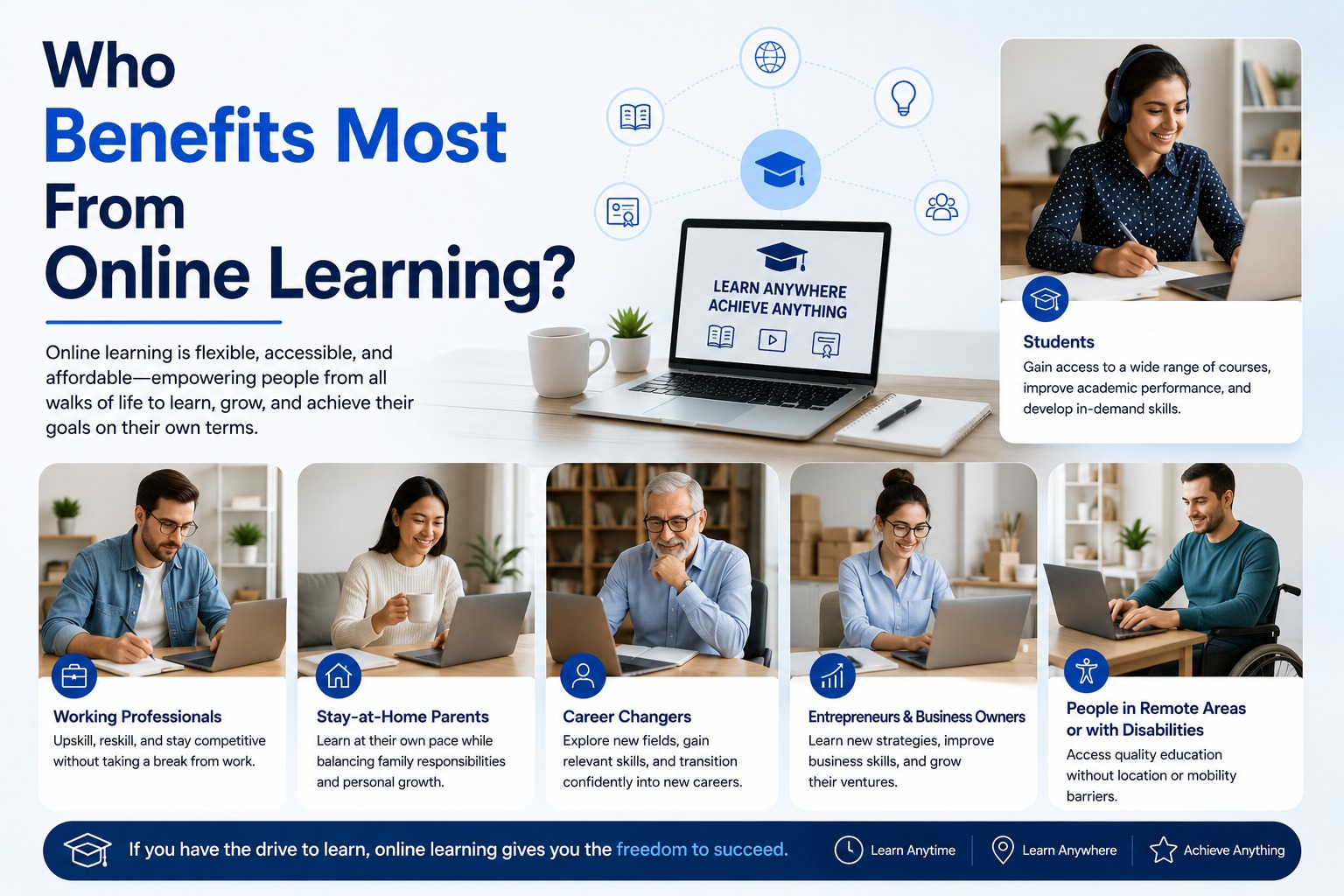
Working Professionals
You can upskill without leaving your job.
Parents and Caregivers
Flexible schedule lets you balance responsibilities and learning.
People in Smaller Cities
Access to world-class content regardless of your location.
Introverts and Shy Students
Less pressure in virtual environments. You can be yourself.
Fast Learners
You’re not held back by the class pace.
Slow Learners
You can take more time without feeling rushed.
Career Changers
You can learn a new field without quitting your job.
Curious Minds
You can explore interests that might not be available locally.
How to Choose the Right Online Learning Platform
Check Credibility
Is the course provider recognized? Do employers accept their certificates? Read reviews from actual students.
Understand the Format
Do you want live classes or self-paced? Interactive or independent? Choose based on your learning style.
Look at Course Content
Read the syllabus. Watch sample videos. Is the content current and relevant?
Consider the Price
Expensive doesn’t always mean better. Affordable doesn’t mean low quality. Compare options.
Check Student Support
Can you ask questions? Is there a community? Good support matters a lot.
Free Trial Options
Many platforms offer free trials or free courses. Use them to test before committing.
Verify Outcomes
Do people get jobs after taking the course? Do they earn more? Check success stories.
FAQs
1. Is Online Learning as Effective as Classroom Learning?
Yes, research shows that online learning can be just as effective, sometimes even more effective. Why? Students can learn at their own pace, review content, and focus without distractions. However, effectiveness depends on course quality and student commitment. A well-designed online course beats a poorly-taught classroom lecture.
2. Will Online Learning Replace Traditional Education?
Not completely. Physical schools and colleges will remain important, especially for young children who need structure and social interaction. But the mix will keep shifting. Most institutions now offer some form of online learning. The future is likely a blend of both.
3. Are Online Certificates Recognized by Employers?
It depends on the course and provider. Certificates from well-known platforms (Coursera, Udacity, Google, Microsoft) are increasingly recognized. However, a degree from a top university still carries more weight than a certificate from an unknown platform. Choose courses from reputable sources.
4. How Much Time Should I Spend on Online Courses?
It varies. Some courses require 5-10 hours per week, others 20-30 hours. Check the course details before enrolling. Be realistic about how much time you can dedicate. Consistency matters more than intensity.
5. Can I Take Multiple Online Courses at the Same Time?
Technically yes, but practically, it’s tough. Most people manage one or two courses comfortably. Taking three or more often leads to dropping out. Focus on depth rather than quantity. Complete one course before starting another, unless you’re sure you can handle multiple.
Conclusion: Why Online Learning Matters Now More Than Ever
What is online learning? It’s not just about watching videos. It’s a complete revolution in how we access knowledge, develop skills, and grow professionally. Companies like Dynamic Pixel are transforming digital education with engaging eLearning solutions, interactive content, and modern learning experiences for businesses and learners worldwide.
Online learning has democratized education. A student in a village can learn from instructors in Silicon Valley. A 45-year-old professional can switch careers without taking a break. A parent can pursue education while managing a household.
Yes, it has challenges. Yes, it requires discipline. But the opportunities are massive.
Whether you’re looking to advance your career, explore a new skill, or satisfy your curiosity, online learning offers a path. The world’s best content is available at your fingertips. All you need is a device, internet, and the willingness to learn.
The question isn’t whether online learning is right for you—it’s which course will you take first?
If you’ve been thinking about starting an online course, stop thinking and start searching. The right platform and course are waiting for you. Your future self will thank you for taking the first step today.