Introduction
Someone sends you a message: “Let’s join a virtual meeting tomorrow.”
You think they mean an online meeting. So you show up the next day, expecting to see everyone through a video call. But wait—your colleague is actually calling you on the phone. No camera, no screens, just voices.
This happens all the time, doesn’t it?
We use the words “online” and “virtual” like they’re the same thing. People say “virtual classroom” when they mean online learning. They say “virtual conference” when they mean an online event with video. The confusion is real, and honestly, it’s making communication harder than it needs to be.
Here’s the truth: Online and virtual are not the same thing. They’re different concepts that serve different purposes. And once you understand the difference, you’ll see why it matters.
In this guide, we’re going to break down what virtual meaning really is, what online actually means, and why we need to stop calling all online interactions “virtual.” By the end, you’ll be able to use these terms correctly and understand exactly what someone means when they use them.
The Basic Difference: Online vs. Virtual
Let’s start simple.
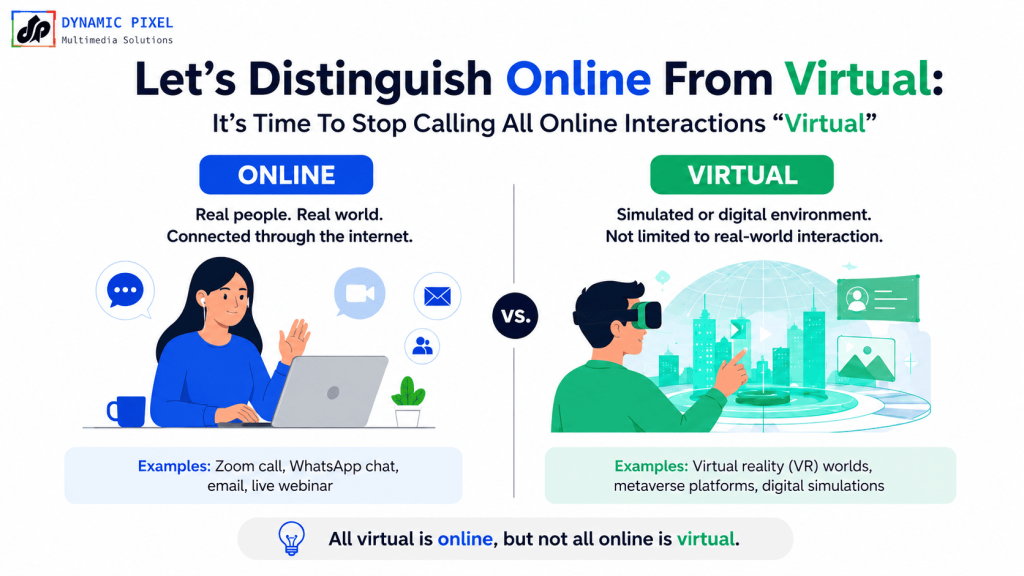
Online means something that happens over the internet. You’re connected to the web, using digital platforms and networks. Email is online. Browsing websites is online. Video calls are online. Social media is online.
Virtual means something that’s not physically real. It’s a simulation or imitation of something that exists in the real world. A virtual assistant that responds to your voice is virtual—it’s not a real person, just software mimicking one. A virtual pet is virtual—it’s not a real animal, just pixels on a screen.
Here’s the key insight: All virtual things are online, but not all online things are virtual.
Think of it this way. If your friend calls you on WhatsApp video, that’s online (using the internet) but it’s not really virtual. Your friend is real. The conversation is real. The only “virtual” part is the medium—the technology connecting you both.
But if your company uses a virtual assistant chatbot to answer customer questions, that’s both online AND virtual. It’s using the internet and the assistant isn’t real.
See the difference?
What Does Virtual Mean? Understanding the Real Definition
To truly understand the difference, we need to nail down what does virtual mean.
Virtual comes from the Latin word “virtus,” meaning strength or power. But in modern usage, it means something that appears to exist or function as specified, but isn’t physically real.
Here are some clear examples:
Real Virtual Scenarios
A virtual reality game. You’re wearing a VR headset. You’re in a completely created world that doesn’t exist in real life. That’s genuinely virtual. You’re experiencing something simulated, not real.
A virtual assistant software. Alexa, Siri, Google Assistant—these are virtual. They’re not real people. They’re AI-powered programs that imitate a personal assistant.
A virtual office. Some companies use 3D virtual spaces where employees have avatars, walk around, and interact. That’s virtual—it’s simulating a real office but in a digital space.
A virtual event with avatars. Imagine attending a concert where everyone appears as digital characters, not themselves. That’s virtual. You’re representing yourself through a different form.
These aren’t just online. They involve something that’s simulated, not real.
Things That Are Online But NOT Virtual
A Zoom meeting. You’re on the internet, yes. But there are real people on that call. You’re not simulating anything. You’re just connecting through technology. It’s online, not virtual.
Reading a blog post. You’re online, but you’re reading actual content from a real person. It’s not a simulation of anything.
An email conversation. Online, yes. But the communication is real. The person is real. Not virtual.
A phone call through the internet. You’re using the web, but the conversation is genuine and real. The other person is real. Not virtual.
Why We Keep Confusing These Terms
There are real reasons why people mix up “online” and “virtual.”
1. Tech Companies Use Them Interchangeably
Microsoft Teams talks about “virtual meetings.” Zoom calls them “virtual conferences.” But honestly, they’re just online meetings with video. There’s nothing simulated or unreal about them.
This marketing language stuck around, and now everyone uses it.
2. The Rise of Remote Work
When offices went remote during the pandemic, companies started calling online work “virtual work.” The term became common, even though it wasn’t technically correct. You’re still doing real work. You’re just doing it online.
3. People Don’t Know the Actual Definitions
Most people never learned the precise meaning of “virtual.” They just heard it used loosely and started using it the same way.
4. Convenience
“Virtual” became a catch-all term for “anything digital or online.” It’s easier to say “virtual meeting” than explaining “an online video meeting where real people interact.”
So the confusion isn’t your fault. The tech industry and marketing have blurred these lines intentionally.
Virtual Information: What It Really Means
When people talk about virtual information, what are they actually referring to?
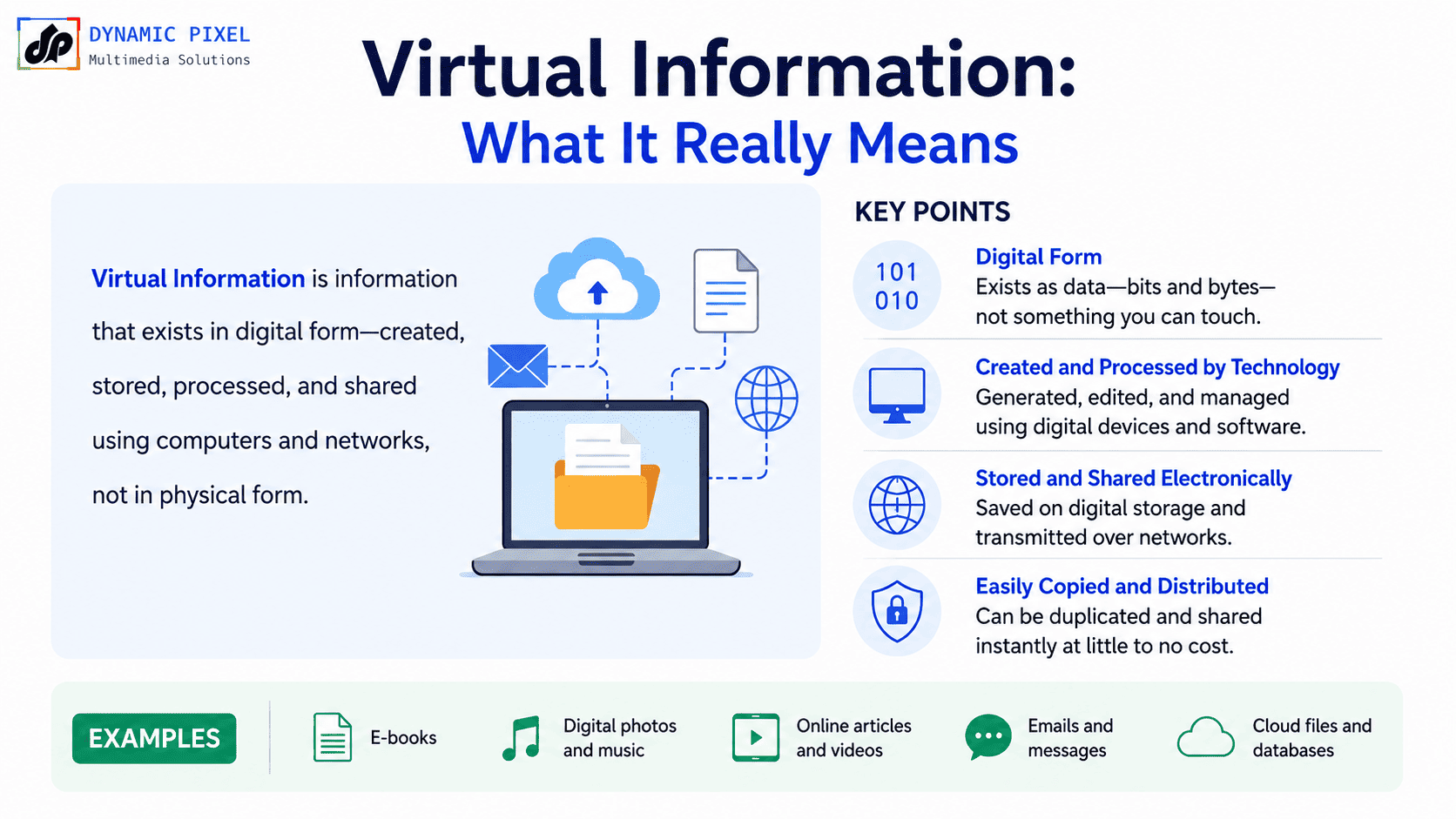
Virtual information is data or content that exists only in digital form, often representing or simulating something that would exist in physical space.
Examples of Virtual Information
A digital map. It’s not a real place, but a virtual representation of a real place. The information about streets, landmarks, and locations is presented in a simulated format.
A 3D model in architecture software. An architect creates a virtual building before it’s constructed in real life. That’s virtual information—a digital simulation of what could exist.
Digital financial records. The money doesn’t exist physically, but the information about it does. It’s virtual in the sense that it’s not a physical thing.
A video game world. All the information about the landscape, characters, and objects is virtual. None of it is real.
But here’s where it gets confusing again: A Wikipedia article is online information, but it’s not really virtual. It’s real information presented online.
So virtual information specifically refers to data that represents something simulated or not physically real. Not just any information on the internet.
Practical Examples: Seeing the Difference in Real Life
Let’s use situations you’ll recognize:
Scenario 1: Your Company’s Team Meeting
The situation: Your boss says “We’re having a virtual team meeting tomorrow at 3 PM. Join on Zoom.”
What’s happening: This is an online meeting (you’re using the internet) where real team members interact. Your boss, your colleagues—they’re all real people. The interaction is real.
Should it be called virtual? Not really. It’s an online meeting. But everyone calls it virtual anyway, and you understand what they mean.
Scenario 2: An Online Game You Play
The situation: You’re playing a multiplayer online game where your character explores a fantasy world.
What’s happening: This is both online and virtual. You’re connected to the internet (online), and you’re in a completely simulated world that doesn’t exist (virtual).
Should it be called virtual? Yes, absolutely. The entire world is virtually created.
Scenario 3: A Customer Service Chatbot
The situation: You message a company, and an AI responds to your questions instantly.
What’s happening: This is online (using the internet) and virtual (the assistant isn’t a real person, just software).
Should it be called virtual? Yes. It’s genuinely virtual because the assistant isn’t real.
Scenario 4: An Online Course
The situation: You’re taking a course on Udemy where a real instructor teaches through recorded videos.
What’s happening: This is online (you’re on the internet). But the instructor is real, the content is real, the teaching is real.
Should it be called virtual? Not exactly. It’s online learning. Calling it “virtual learning” suggests something simulated, which isn’t accurate.
These examples show how the words get mixed up. In most daily interactions, people use “virtual” when they really mean “online.”
Why This Distinction Actually Matters
You might be thinking: “Does it really matter? Everyone understands what I mean anyway.”
Fair point. But here are reasons why the distinction is worth keeping:
1. Clear Communication
When you say “virtual classroom,” does that mean:
- A simulated classroom in VR where students have avatars?
- OR an online video class where real students learn?
They’re completely different experiences. Precision saves confusion.
2. Technology Planning
If a company says they’re moving to “virtual work,” they might mean:
- Remote work using online tools (likely)
- OR work in a metaverse where employees have avatars (very different)
Understanding the exact meaning helps with planning and expectations.
3. Budget and Resources
Virtual training might require expensive VR equipment. Online training just needs a video platform. Mixing up the terms costs money.
4. Educational Accuracy
Students learning about technology should understand these terms correctly. If they don’t, they’ll keep spreading the confusion.
5. Credibility
When you use precise language, people take you more seriously. You sound like someone who knows what they’re talking about.
The Right Way to Use These Terms
Here’s a quick guide for using these words correctly:
Use “Online” When:
- Something happens over the internet
- People are connecting through digital networks
- Content is accessed through the web
- Real interaction is happening through digital means
Examples: Online shopping, online meeting, online course, online community, online banking
Use “Virtual” When:
- Something is simulated or not physically real
- You’re experiencing something created digitally that doesn’t exist in reality
- The thing isn’t real but appears functional
- Technology is creating something that mimics real life
Examples: Virtual reality, virtual assistant, virtual environment, virtual world, virtual pet
Avoid These (They’re Confusing):
- “Virtual meeting” (it’s an online meeting)
- “Virtual classroom” (unless it’s actually in VR, then it’s okay)
- “Virtual learning” (online learning is better; virtual learning suggests simulation)
- “Virtual work” (remote work or online work is more accurate)
Virtual in Different Fields
The word “virtual” means slightly different things depending on the context:
In Technology
Virtual means something that’s created by software and doesn’t exist physically. A virtual machine is a computer created by software inside another computer. It’s not real hardware, but it functions like one.
In Business
Virtual often just means “using online tools.” A virtual assistant is someone who works remotely for you (though technically, they’re real). This usage is loose and sometimes incorrect, but it’s common.
In Entertainment
Virtual usually means simulated. Virtual reality is a completely created digital environment. Virtual characters are digital beings that don’t exist in real life.
In Education
Virtual has gotten mixed up with online. “Virtual classroom” should mean a simulated classroom in VR, but people use it to mean any online class. The distinction matters here.
In Medicine
Virtual consultations are real doctors speaking with real patients online. The word here is used loosely and doesn’t really mean simulated.
The Future: When Virtual Will Be More Common
Right now, most “virtual” things aren’t actually virtual. But this might change.
As technology advances, we’ll see more genuinely virtual experiences:
Metaverse and Web3
Companies are building immersive virtual worlds. People will create avatars and interact in spaces that don’t exist physically. That’s truly virtual.
Advanced VR
VR technology is getting better every year. Soon, VR experiences might be common in education, training, and entertainment. These will be genuinely virtual.
AI Avatars
Instead of seeing someone’s face on a video call, you might see an AI-created avatar that represents them. That’s virtual.
Holographic Communication
Imagine seeing a 3D hologram of someone in your room instead of a video on your screen. Is that virtual? It’s harder to say. It’s more immersive than online video, but the person is real.
When these technologies become common, the word “virtual” will be used more accurately. The distinction between online and virtual will matter more.
FAQs
1. Is a Zoom call virtual or online?
A Zoom call is online. You’re connecting through the internet, and real people are communicating. Nothing is simulated. The word “virtual meeting” is commonly used, but it’s technically incorrect. It’s an online meeting using video. You could say “virtual Zoom meeting” only if people were using avatars instead of showing their faces, which they’re not.
2. Can something be online but not virtual?
Absolutely. Most things online aren’t virtual. Websites, social media, emails, video calls—these are all online, but the content and communication are real, not simulated. Virtual is a specific term that should only apply when something is simulated or not physically real.
3. What’s an example of something that’s both online and virtual?
A video game is a perfect example. It’s online (if you’re playing multiplayer with internet connection) and virtual (the entire game world is simulated and doesn’t exist physically). Another example is a VR experience accessed through the internet—it’s online and virtual.
4. Why do companies keep using “virtual” incorrectly?
Marketing. The word sounds more modern and tech-savvy than “online” or “remote.” During the pandemic, “virtual work” and “virtual meetings” became common phrases, and they stuck. Plus, it’s simpler than saying “remote video conference.” Language evolves based on usage, even when it’s technically inaccurate.
5. Does it really matter if I use these words incorrectly?
In casual conversation, probably not. People understand you anyway. But in professional contexts, technical writing, or education, precision matters. Using the right word shows you understand the difference between a real online interaction and something that’s actually simulated. It also prevents confusion when discussing technology or planning resources.
Conclusion: It’s Time to Distinguish Online From Virtual
We’ve covered a lot here. Let’s recap the core idea: Online and virtual aren’t the same, and it’s time we stopped treating them that way.
Online means something happens over the internet. Virtual means something is simulated and not physically real. The confusion happened because companies used “virtual” as a marketing term for anything digital, and the rest of us just followed along.
But here’s the thing—understanding the difference makes you a clearer communicator. When you say “online meeting,” people know what you mean. When you say “virtual reality,” people understand you’re talking about a simulated experience.
The tech world is moving toward more genuinely virtual experiences. Metaverses, advanced VR, AI avatars—these are coming. When that happens, distinguishing online from virtual won’t be an academic exercise. It’ll be essential for understanding what you’re actually doing.
So next time someone says “virtual meeting,” gently correct them. Or use the right word yourself. Share this knowledge with colleagues and friends. Small changes in language create clearer thinking.
The internet is online. Simulations are virtual. Learn the difference, use the words right, and you’ll stand out as someone who actually knows what they’re talking about.
Your communication will be clearer. Your technical understanding will be deeper. And honestly? You’ll help fix a confusion that’s been bothering language enthusiasts for years.
Start today with Dynamic Pixel. Change how you talk about these things. Because words matter, and precision in language matters even more.