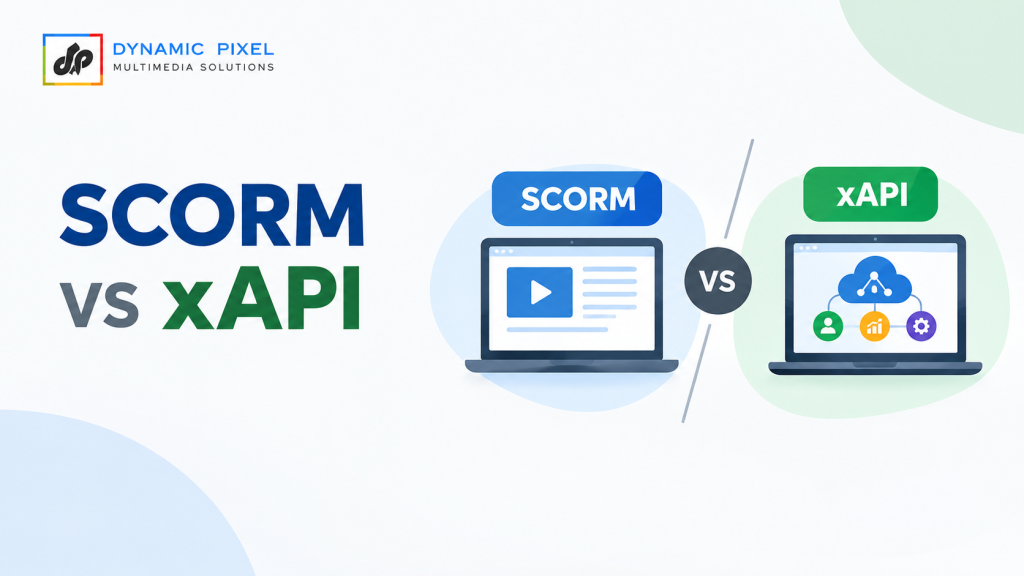
SCORM vs xAPI comes down to how much tracking detail you actually need. SCORM (Sharable Content Object Reference Model), developed by the ADL Initiative in the early 2000s, tracks basic metrics — completion, score, pass/fail — inside your LMS, and remains the most widely supported eLearning standard. xAPI (Experience API, also called Tin Can), released in 2013, tracks far more granular learner activity across multiple platforms and devices — including offline and mobile learning — by storing data in an external Learning Record Store (LRS). If you need straightforward, LMS-based tracking with maximum compatibility, choose SCORM. If you need to track learning across simulations, mobile apps, or offline activities, xAPI is built for that.
Introduction
If you’re building or buying eLearning content, you’ll run into this decision sooner or later: should your courses use SCORM, xAPI, or does it even matter? It matters more than most people realize — the standard you choose affects what you can actually measure about your learners, which platforms your content will work on, and how much technical setup you’re signing up for.
This guide breaks down what SCORM and xAPI actually do, their real benefits, and how to decide which one fits your training needs.
What Is SCORM?
SCORM (Sharable Content Object Reference Model) is a technical standard governing how eLearning content packages, launches, and communicates tracking data to a Learning Management System. It was developed under the U.S. Department of Defense’s Advanced Distributed Learning (ADL) Initiative, with SCORM 1.2 released in 2001 and the more advanced SCORM 2004 following shortly after.
SCORM content is packaged as a ZIP file containing a manifest file (imsmanifest.xml) that tells the LMS what’s inside and how to launch it. Once launched, the course communicates with the LMS via JavaScript API calls, reporting data like completion status, score, and time spent — commonly referred to as the “Big 4” tracking metrics.
Benefits of SCORM
- Near-universal LMS compatibility — SCORM is supported by the vast majority of Learning Management Systems on the market, making it the safest default for broad reach
- Mature, well-documented standard — two decades of industry adoption means extensive documentation, community support, and authoring tool compatibility
- Simple, reliable tracking — for straightforward compliance and completion tracking, SCORM covers what most organizations actually need
- Faster implementation — SCORM’s structure is well understood by most LMS platforms and authoring tools, meaning less custom setup
- Content reusability — SCORM packages can be reused across different courses and platforms without rebuilding them
- Cost-efficient — no additional infrastructure (like an external Learning Record Store) is required; your existing LMS handles everything
What Is xAPI?
xAPI (Experience API), also known as Tin Can, is a newer eLearning standard released in 2013, designed to track learning experiences far beyond what SCORM can capture — including activities happening outside a traditional LMS entirely, like mobile apps, simulations, VR training, and offline learning.
xAPI works through simple statements structured as actor–verb–object — for example, “Sarah completed the onboarding module” or “Raj passed the safety assessment.” These statements are sent to an external Learning Record Store (LRS), rather than being stored inside the LMS itself, which is what allows xAPI to aggregate data from multiple sources beyond a single course platform.
Benefits of xAPI
- Tracks learning beyond the LMS — captures activity from simulations, mobile apps, video platforms, and even real-world/offline activities
- Granular, detailed data — goes beyond completion and score to record specific interactions, video engagement, and behavior patterns
- Offline learning support — xAPI statements can be recorded offline and synced to the LRS once a connection is available
- Cross-platform flexibility — since data lives in an external LRS rather than a single LMS, it can be aggregated across multiple tools and platforms
- Stronger security model — xAPI typically uses OAuth-based authentication, considered more robust than SCORM’s browser-based communication
- Better fit for modern learning formats — well suited to VR/AR training, gamified learning, and blended experiences that don’t fit neatly into a single course structure
SCORM vs xAPI: Key Differences at a Glance
| SCORM | xAPI | |
|---|---|---|
| Released | 2001 (SCORM 1.2), 2004 (SCORM 2004) | 2013 |
| Data storage | Inside the LMS | External Learning Record Store (LRS) |
| Tracking depth | Basic — completion, score, time spent, pass/fail | Granular — detailed interactions, multi-platform activity |
| Works outside the LMS | No | Yes — apps, simulations, offline activities |
| Offline support | Depends on the specific LMS | Built-in by design |
| Setup complexity | Lower — most LMS platforms support it natively | Higher — requires an LRS and xAPI-aware tools |
| Security model | Browser-based JavaScript communication | OAuth-based, generally considered more secure |
| Best for | Straightforward compliance training, broad compatibility | Multi-platform tracking, simulations, mobile/offline learning |
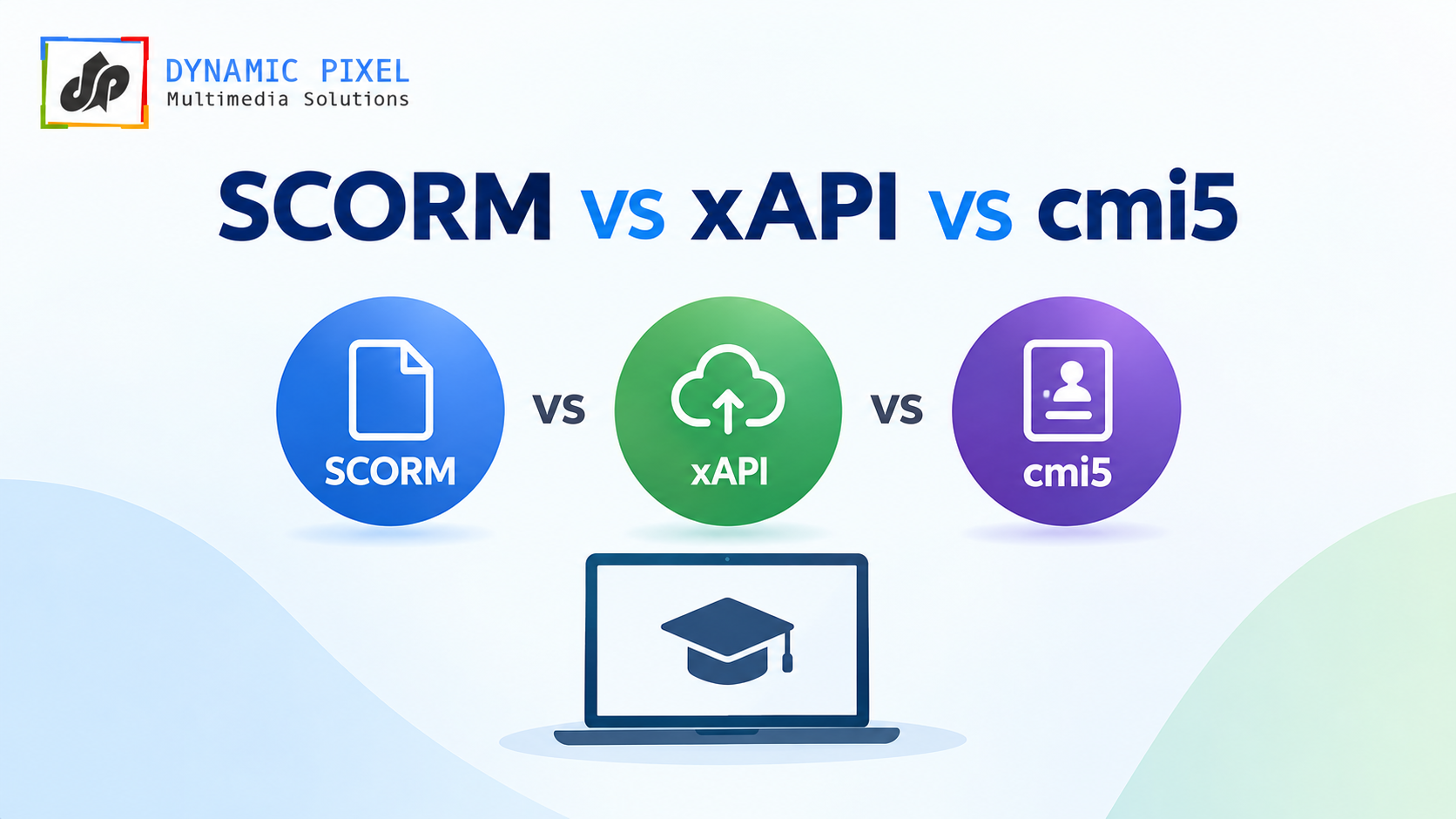
SCORM vs xAPI vs cmi5: Where Does cmi5 Fit In?
If SCORM and xAPI aren’t confusing enough, there’s a third standard worth knowing: cmi5. Think of cmi5 as a bridge between the two — it uses xAPI’s underlying data model and tracking power, but adds back some of SCORM’s structured packaging and launch behavior that xAPI intentionally left undefined.
| Factor | SCORM | xAPI | cmi5 |
|---|---|---|---|
| Packaging structure | Strictly defined | Not defined (flexible) | Defined, xAPI-based |
| Tracking depth | Basic | Advanced | Advanced (xAPI-powered) |
| LMS adoption | Very high | Growing | Still emerging |
| Best fit | Simple compliance courses | Multi-platform, informal learning | Organizations wanting xAPI’s power with more structure |
cmi5 is worth watching, but as of 2026 it hasn’t reached SCORM’s near-universal LMS support, making it a forward-looking option rather than a safe default today.
How to Choose: SCORM or xAPI?
Choose SCORM if:
- You need broad compatibility across most LMS platforms
- Basic tracking (completion, score, pass/fail) is genuinely sufficient
- You want the fastest, lowest-overhead implementation
- Your training is straightforward — standard courses, not simulations or multi-platform experiences
Choose xAPI if:
- Your training spans multiple platforms — mobile apps, simulations, VR/AR, or informal learning
- You need detailed behavioral data, not just completion and scores
- Offline learning is a genuine part of your training strategy
- You’re building for the long term and want a more future-facing tracking architecture
Can you use both? Yes. Many modern authoring tools can export content in either format, and some organizations run SCORM for standard compliance courses while using xAPI for more complex, multi-platform training initiatives. The two aren’t mutually exclusive across your broader training ecosystem — the decision is really per-course or per-program, not organization-wide.
FAQs
Q1. What are the key differences between LTI and SCORM?
LTI (Learning Tools Interoperability) and SCORM solve different problems. SCORM packages and tracks self-contained course content within an LMS. LTI, by contrast, is designed to launch and integrate external tools and applications (like a plagiarism checker or a third-party assessment tool) into an LMS with single sign-on and grade passback, without needing the external tool’s content to be “packaged” the way SCORM requires.
Q2. What is the difference between SCORM and an LMS?
An LMS (Learning Management System) is the software platform that hosts, delivers, and manages training courses. SCORM is a technical standard that defines how course content packages and communicates tracking data to that LMS. In short: the LMS is the platform, SCORM is the language the content uses to talk to it.
Q3. What is SCORM vs xAPI vs cmi5, and which should I use?
SCORM offers the broadest LMS compatibility with basic tracking; xAPI offers the deepest tracking across multiple platforms but requires an external LRS; cmi5 combines xAPI’s tracking power with more structured packaging, though it has less widespread LMS adoption than SCORM as of 2026. Most organizations should default to SCORM for standard training and consider xAPI specifically when multi-platform or offline tracking is a real requirement.
Q4. Is xAPI better than SCORM?
Not universally — xAPI offers more detailed tracking and cross-platform flexibility, but it requires more setup (an LRS) and isn’t necessary for straightforward compliance training. SCORM remains the more practical choice when broad compatibility and simple tracking are what you actually need.
Q5. Can I convert SCORM content to xAPI?
Many modern authoring tools can export the same course in either SCORM or xAPI format, though a true conversion that captures xAPI’s full tracking depth may require rebuilding tracking logic rather than a simple one-click export, especially for courses originally designed around SCORM’s more limited data model.
Q6. Does xAPI require internet access to work?
No — this is one of xAPI’s key advantages. Learning activity can be tracked offline and stored locally, then synced to the Learning Record Store once an internet connection becomes available, unlike SCORM, whose offline capability depends heavily on the specific LMS being used.
Sources
- ADL (Advanced Distributed Learning) Initiative — SCORM Standards Documentation
- xAPI (Experience API) Specification — ADL Initiative
Related Reading
- What Is SCORM and How Do You Make Your Course SCORM Compliant?
- Moodle LMS Solutions & Services
- AI-Based Learning Platform: Examples, Features & Top LMS
Need Help Choosing the Right Standard for Your eLearning Content?
Whether your training needs straightforward SCORM packaging or advanced xAPI tracking across multiple platforms, Dynamic Pixel builds custom eLearning content and Moodle LMS implementations tailored to your tracking and reporting needs. Get in touch to discuss your project.