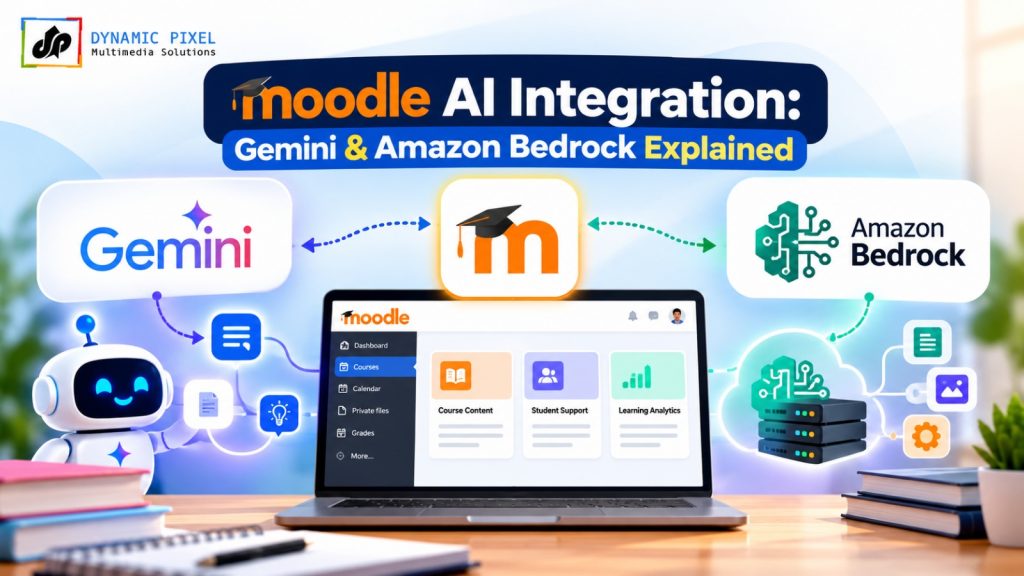
Moodle AI integration works through a plug-in “AI provider” system built into Moodle’s core since version 4.5. As of Moodle 5.2 (released April 2026), the Gemini API provider is a native, officially supported option — letting you power Moodle’s AI features (text generation, image generation, content summarising) using Google’s Gemini models. The Amazon Bedrock API provider, built by AWS partner Meeple Srl (a University of Padua spin-off), connects Moodle to Bedrock’s foundation models — including Anthropic’s Claude — with a key advantage: your institution’s data stays inside your own AWS account and is never sent to the model provider directly, which matters significantly for GDPR and data-sovereignty requirements.
What Is Moodle’s AI Provider System?
Moodle doesn’t build its own AI models — instead, it has an AI subsystem (introduced in Moodle 4.5) that acts as a connector, letting you plug in whichever AI service you prefer. Each connection is called an “AI provider.” As of Moodle 5.2, the officially supported providers include:
- Gemini API provider — Google’s Gemini models (new in 5.2)
- OpenAI API provider — requires an OpenAI account and paid API plan
- Ollama provider — connects to locally-hosted, self-managed models on your own server
- Amazon Bedrock API provider — connects to AWS Bedrock’s foundation models, including Anthropic Claude
This “bring your own AI provider” approach means your institution chooses which AI vendor to trust with data and cost, rather than being locked into one option.
Gemini AI to Moodle: How It Works
The Gemini API provider is one of Moodle 5.2’s headline new features. Once configured, it powers several AI capabilities directly inside the Moodle interface:
- Generating text — drafting content, descriptions, or course material starting points
- Generating images — creating visuals for courses without needing separate design tools
- Summarising content — condensing long text into shorter, digestible summaries for learners or staff
Setting Up Gemini as a Moodle AI Provider
- Get a Google API key from Google AI Studio
- In Moodle: go to Site Administration → AI → AI Providers
- Add and configure the Gemini provider with your API key
- Enable the specific AI features (text generation, image generation, summarisation) you want available to your users
This is the most accessible route for institutions already comfortable with Google’s ecosystem, since it doesn’t require AWS infrastructure or a dedicated cloud team.
Moodle LMS Integration with Amazon Bedrock: How It’s Different
The Amazon Bedrock API provider takes a fundamentally different architectural approach — and this difference matters if data privacy and compliance are a priority for your institution.
What Makes Bedrock’s Integration Distinct
- Data stays inside your own AWS account. Unlike providers where your data is sent directly to the model vendor (Google, OpenAI), Bedrock’s architecture keeps everything within the institution’s controlled AWS environment
- Access to multiple foundation models, including Anthropic’s Claude, through a single integration — Bedrock is a multi-model gateway, not a single vendor’s model
- Built specifically for GDPR-sensitive institutions — data never leaves the institution’s own account, which significantly simplifies compliance discussions around data sovereignty and the “right to be forgotten”
- Requires Moodle 4.5 or later (the first version with the AI subsystem)
- Requires a paid AWS subscription — this isn’t a free integration, since you’re paying AWS directly for model usage
Real-World Example: University of Padua’s “Lucrez-IA”
The Amazon Bedrock provider for Moodle was originally built to power the University of Padua’s “Lucrez-IA” virtual assistant project — making it, according to AWS’s own account, the first public university in Italy to deploy a generative AI solution based on Anthropic’s Claude models. The integration works through custom Moodle blocks with Single Sign-On, giving faculty AI assistance directly at the point of teaching — helping develop course materials, respond to student questions, and handle administrative tasks. The plugin is now publicly available through Moodle’s official plugin directory and GitHub.

Gemini vs. Amazon Bedrock: Which Moodle AI Provider Fits Your Institution?
| Factor | Gemini API Provider | Amazon Bedrock API Provider |
|---|---|---|
| Setup complexity | Simpler — just a Google API key | More involved — requires AWS account and setup |
| Minimum Moodle version | 5.2 | 4.5 |
| Data handling | Sent to Google’s infrastructure | Stays within your own AWS account |
| Model access | Google’s Gemini family only | Multiple foundation models, including Claude |
| Best fit for | Institutions wanting quick setup with Google’s ecosystem | Institutions with strict GDPR/data-sovereignty requirements |
| Cost model | Google AI Studio API pricing | Paid AWS subscription, usage-based |
Why Moodle AI Integration Matters Beyond the Novelty Factor
For institutions and organizations already running Moodle, AI integration isn’t just a feature checkbox — it changes real day-to-day work:
- Faculty save time drafting course descriptions, summaries, and explanatory content
- Students get AI-assisted summaries of long course material, supporting different learning paces
- Administrative tasks — responding to routine queries, generating reports — can be partially automated
- Institutions retain control over which AI vendor handles their data, rather than a one-size-fits-all AI feature baked into the platform
Common Questions Before Choosing a Provider
Before setting up any AI provider in Moodle, it’s worth answering:
- Does our institution have specific data residency or GDPR requirements? If yes, Bedrock’s architecture is worth serious consideration over Gemini or OpenAI.
- Do we already have cloud infrastructure in place? An existing AWS relationship makes Bedrock’s setup considerably smoother; a Google Workspace-centric institution may find Gemini more natural.
- What’s our budget model preference? Both are usage-based, but the underlying pricing structures and included features differ.
- Do we need multi-model flexibility? Bedrock’s gateway approach gives access to several foundation models through one integration, which some institutions value for future flexibility.
FAQs
Q1. What is Moodle AI integration?
Moodle AI integration refers to Moodle’s built-in AI subsystem (since version 4.5), which connects the LMS to external AI providers like Gemini, OpenAI, Amazon Bedrock, or locally-hosted models via Ollama, powering features like text generation, image generation, and content summarisation.
Q2. How do I connect Gemini AI to Moodle?
Get a Google API key from Google AI Studio, then configure it under Site Administration → AI → AI Providers in Moodle 5.2 or later, enabling the specific AI features you want to activate.
Q3. How does Moodle LMS integration with Amazon Bedrock work?
The Amazon Bedrock API provider, built by AWS partner Meeple Srl, connects Moodle (version 4.5+) to Bedrock’s foundation models, including Anthropic’s Claude, while keeping institutional data inside the organization’s own AWS account rather than sending it to the model provider directly.
Q4. Which Moodle AI provider is best — Gemini or Amazon Bedrock?
It depends on your priorities. Gemini offers simpler setup for institutions in the Google ecosystem, while Amazon Bedrock is better suited to institutions with strict GDPR or data-sovereignty requirements, since data never leaves their own AWS account.
Q5. Do I need a paid subscription to use these Moodle AI providers?
Yes, both require a paid account with the respective provider — a Google AI Studio API plan for Gemini, and a paid AWS subscription for Bedrock — since you’re paying for the underlying model usage.
Q6. What Moodle version do I need for AI provider integration?
The AI subsystem was introduced in Moodle 4.5, which is the minimum version required for the Amazon Bedrock provider. The Gemini API provider specifically requires Moodle 5.2 or later.
Sources
- MoodleDocs — AI Providers, Official Moodle Documentation
- Moodle Plugins Directory — Amazon Bedrock API Provider
- AWS Public Sector Blog — Meeple, Padua University Spin-off, Launches Amazon Bedrock AI Plugin for Moodle
- AWS Prescriptive Guidance — Generative AI Integration Patterns for Learning Management Systems
Related Reading
- SCORM vs xAPI: Which Standard Should You Choose for eLearning?
- AI-Based Learning Platform: Examples, Features & Top LMS
- Moodle LMS Solutions
Need Help Setting Up AI on Your Moodle Platform?
As a Certified Moodle Partner, Dynamic Pixel helps institutions configure, customize, and integrate AI providers — including Gemini and Amazon Bedrock — into their Moodle environment, matched to their specific data and compliance requirements. Get in touch to discuss your Moodle AI setup.