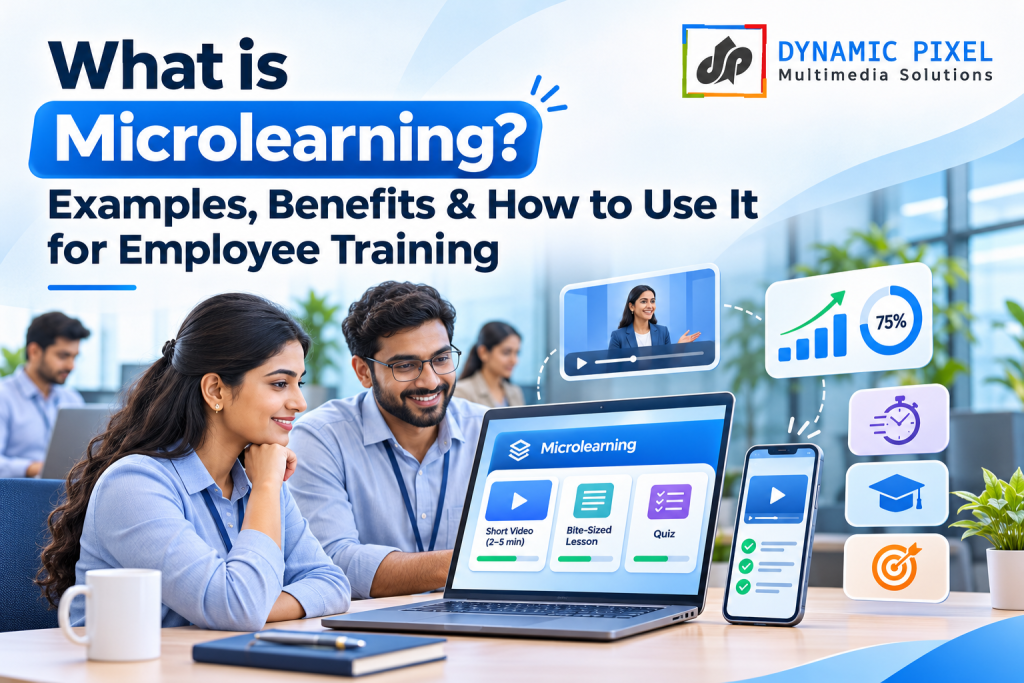
What is Microlearning?
Microlearning is a training method that teaches one skill or idea at a time in short, focused lessons, usually 2 to 10 minutes long. Learners can open a lesson on their phone or laptop when they need it, often in the middle of work. Common formats include short videos, quizzes, infographics, flashcards, job aids and quick scenarios.
The Association for Talent Development (ATD) describes microlearning as short content that covers only the “need to know” and works best as a complement to longer training, not a full replacement. (ATD)
Key takeaways
- One lesson = one learning objective. If a lesson tries to teach three things, split it.
- ATD’s research found 2 to 5 minute segments were rated most effective, with about 10 minutes as the ideal maximum.
- It works best for refreshers, product knowledge, compliance reminders, safety habits and on-the-job support.
- It is weaker for deep, complex skills unless lessons are sequenced into a larger learning path.
- Walmart and Google have published results from microlearning programs. Both are covered below.
Why Employee Training Needs a Shorter Format
The biggest problem in workplace training is not content. It is time.
The TalentLMS 2026 L&D Report, based on a September 2025 survey of 1,000 U.S. employees and 101 HR managers, found that lack of time was the top obstacle to learning for the third year in a row. 53% of employees said high workloads leave little room for training, and 70% admitted to multitasking during training sessions. (TalentLMS)
An hour-long course competes with real work and usually loses. A 4-minute lesson fits between tasks. That is the practical reason microlearning has grown, alongside the research reasons explained next.
Does Microlearning Work? What the Research Says
Microlearning is based on three well-studied ideas from learning science.
1. People forget fast without review
Hermann Ebbinghaus’s research on memory in the 1880s showed that people forget much of what they learn within days unless they review it. This pattern is known as the “forgetting curve.” A single long training day does little to stop it. Short, repeated lessons do.
2. Spaced practice beats one long session
A large meta-analysis by Cepeda and colleagues, published in Psychological Bulletin in 2006, reviewed hundreds of experiments on spacing. It found that spreading study across separate sessions leads to better long-term recall than cramming the same amount into one sitting. (Cepeda et al., 2006) Microlearning makes spacing easy because lessons are short enough to repeat.
3. Less content per lesson means less overload
Cognitive load theory says working memory can handle only a small amount of new information at once. A lesson with one objective respects that limit. In ATD’s survey, 40% of talent development professionals said microlearning is less likely to overwhelm learners. (ATD)
What studies on microlearning itself show
- A 2019 literature review in Cureus found that microlearning delivered through mobile apps supported knowledge retention and work performance among health professionals. (Shail, 2019)
- A 2019 scoping review in JMIR Medical Education found microlearning promising for health professions education, but noted that more rigorous studies are needed. (De Gagne et al., 2019)
Our honest view: the evidence for spacing and short lessons is strong. The evidence for microlearning as a brand-new method is still growing, and many published numbers come from vendors. Treat vendor statistics with care and measure results in your own organization.
Real Company Microlearning Examples
Walmart: safety training in 3 to 5 minutes a day
Walmart’s logistics division used the Axonify platform to give more than 75,000 associates across 150+ distribution centers 3 to 5 minutes of gamified safety questions each day. Axonify’s published case study reports a 54% reduction in recordable incidents and a 15% gain in safety knowledge. (Axonify case study)
Lesson for you: daily repetition of a few critical behaviors can matter more than a long annual safety course.
Google: “whisper courses” for managers
Google’s People team sent new managers a series of short emails over several weeks. Each email focused on one management behavior, such as recognizing team members, and gave a practical example. Google reported that managers who received these nudges improved on their targeted behaviors compared with a control group. (Google re:Work)
Lesson for you: microlearning does not need an app. A well-timed email can be a lesson.
Everyday examples you already know
Language apps like Duolingo use 5-minute daily lessons, streaks and quick quizzes. The same structure works for workplace training on products, policies and software.
Microlearning Examples by Format
| Format | Typical length | Best used for | Example |
|---|---|---|---|
| Short explainer video | 1 to 3 minutes | Showing a process or concept | How to raise a leave request in the HRMS |
| Interactive scenario | 3 to 7 minutes | Decision-making and soft skills | Handling an angry customer call |
| Quiz or flashcards | 1 to 3 minutes | Recall and spaced review | 5 daily questions on product features |
| Infographic or job aid | Under 1 minute | Quick reference at the point of need | Fire safety checklist on a shop floor |
| Whiteboard animation | 1 to 2 minutes | Simplifying abstract ideas | What is data privacy and why it matters |
| Mini game | 2 to 5 minutes | Engagement and practice | Spot-the-hazard game for warehouse staff |
| Email or chat nudge | Under 2 minutes | Behavior change over weeks | Weekly manager tip, like Google’s whisper courses |
| Podcast snippet | 3 to 5 minutes | Learning on the move | Sales leader shares one objection-handling tip |
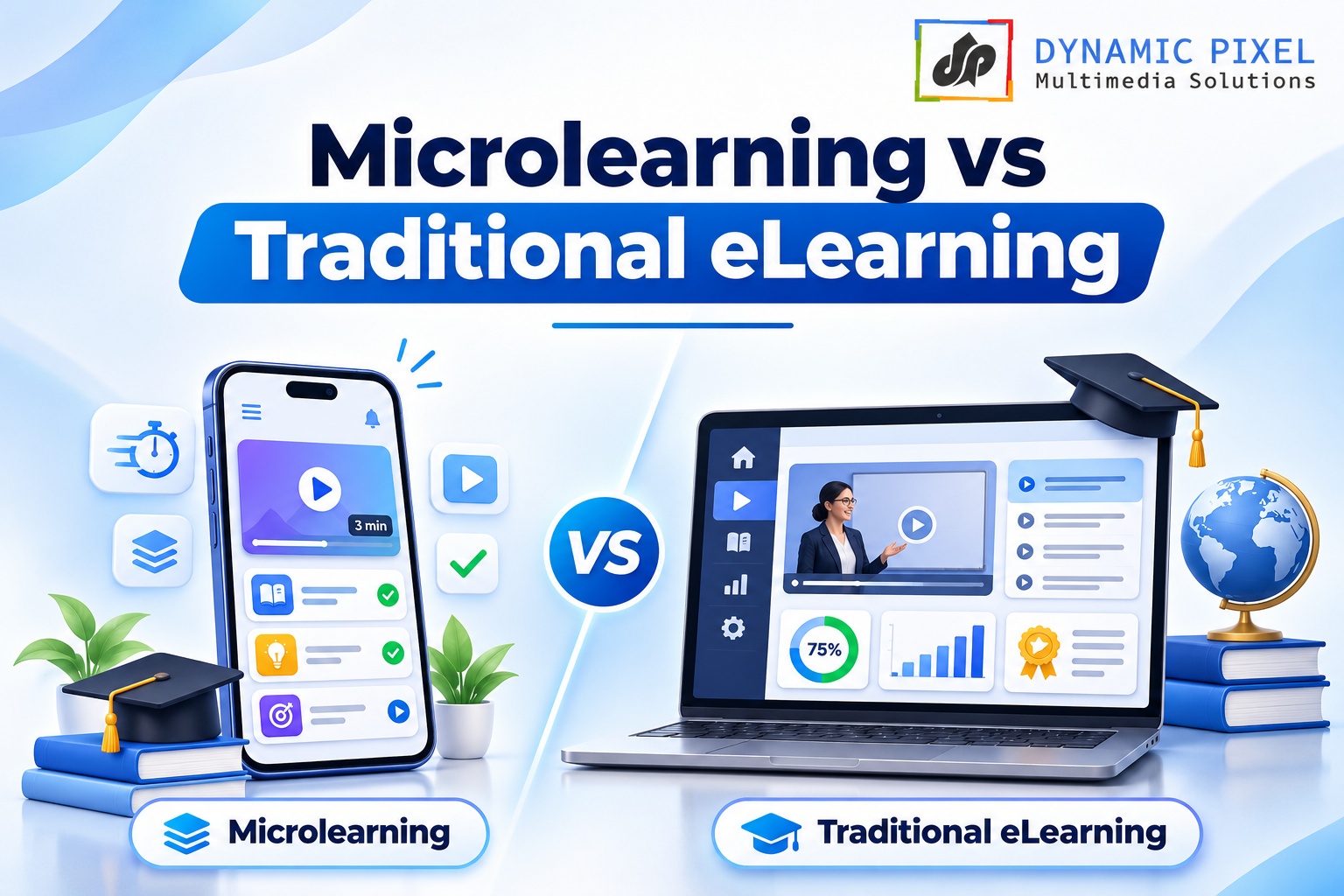
Microlearning vs Traditional eLearning
| Factor | Microlearning | Traditional eLearning / classroom |
|---|---|---|
| Lesson length | 2 to 10 minutes | 30 minutes to several hours |
| Objectives per lesson | One | Many |
| When learners use it | Any time, often during work | Scheduled sessions |
| Device | Mobile-first | Mostly desktop or classroom |
| Updating content | Fast: change one module | Slow: rework the whole course |
| Best for | Refreshers, reinforcement, job support | Deep skills, certification, foundational knowledge |
| Main risk | Fragmented learning if not sequenced | Low completion and fast forgetting |
In practice, the strongest programs combine both. For example, a half-day onboarding workshop followed by four weeks of 3-minute refreshers.
Benefits of Microlearning for Employee Training
- Fits busy schedules. Lessons fit between meetings and shifts, which addresses the top barrier in the TalentLMS report.
- Better long-term recall. Short lessons are easy to repeat, which supports spaced practice.
- Help at the moment of need. A 60-second job aid helps more than a course the employee took six months ago.
- Faster updates. When a policy or product changes, you edit one module, not a full course.
- Works for deskless staff. Retail, factory, field and healthcare workers can learn on a phone.
- Clearer data. Each module links to one objective, so quiz results show exactly which skill needs work.
Limitations to plan for
- Complex skills (like financial analysis or coding) need longer practice and a structured path.
- Too many unrelated modules can feel scattered. Group them into themed learning paths.
- ATD’s survey found one-third of organizations using microlearning cited lack of learner accountability as a barrier. Set clear expectations and track progress.
What is Microlearning in Education?
In education, microlearning means breaking a subject into small lessons that students can finish in a few minutes, each with one clear goal. Teachers use it for revision cards, short concept videos, daily practice quizzes and flipped classroom prep.
Schools and colleges often deliver it through an LMS such as Moodle, using activities like H5P interactive videos and quiz banks. It suits K-12 revision, competitive exam preparation and skill-based college courses. Learn more about our K-12 eLearning solutions and college and institution solutions.
What is Microlearning in Instructional Design?
In instructional design, microlearning is a design approach where each learning object has one measurable objective, minimal content and a quick practice or check. The designer decides what the learner must do differently, then removes everything that does not serve that action.
A simple design template for one micro-lesson
- Objective: one action, written as a verb. Example: “Identify a phishing email.”
- Hook (10 to 20 seconds): a real situation or question.
- Core content (1 to 3 minutes): only the steps or facts needed.
- Practice (1 to 2 minutes): a scenario, quiz or drag-and-drop.
- Feedback: explain why an answer is right or wrong.
- Next step: link to the next module or a job aid.
Practical example: turning a 60-minute course into microlearning
Here is how an instructional designer might split a 60-minute information security course:
| Module | Objective | Format | Length |
|---|---|---|---|
| 1 | Recognize a phishing email | Scenario with 3 sample emails | 4 min |
| 2 | Create a strong password | Explainer video + quiz | 3 min |
| 3 | Lock your screen and secure devices | Infographic | 1 min |
| 4 | Share files safely | Interactive walkthrough | 4 min |
| 5 | Report a security incident | Job aid + 2-question check | 2 min |
| 6 | Spaced review | 5 quiz questions sent on day 7, 14 and 30 | 2 min each |
Each module stands alone, so employees can revisit only the one they need.
How to Use Microlearning for Employee Training: 7 Steps
- Pick a business problem, not a topic. “Reduce billing errors” is better than “Billing training.”
- List the behaviors that solve it. Each behavior becomes one module.
- Choose the right format for each behavior using the format table above.
- Build mobile-first. Use responsive HTML5 or SCORM packages that work on phones. See our mobile learning and SCORM content development services.
- Deliver through a system you can track, such as an LMS, app or chat tool. Our Moodle LMS solutions support learning paths, quizzes and completion reports.
- Schedule spaced reviews. Send short quizzes 1, 2 and 4 weeks after the first lesson.
- Measure behavior, not only completion. Compare error rates, incidents, sales or ticket times before and after.
Microlearning Platforms: How to Choose
Microlearning platforms range from dedicated mobile apps to full LMS systems. Here is a neutral comparison of common options:
| Platform | Type | Strength | Good fit for |
|---|---|---|---|
| Axonify | Dedicated microlearning app | Daily questions, gamification, frontline focus | Large retail and logistics teams |
| SafetyCulture Training (formerly EdApp) | Mobile microlearning LMS | Ready templates, course library | Deskless teams, quick rollout |
| Arist | Chat-based learning | Lessons delivered via SMS, Slack or Teams | Teams that live in messaging tools |
| Moodle LMS (with H5P) | Open-source LMS | Full control, no per-user license fee, custom plugins | Organizations wanting ownership and customization |
| TalentLMS / Docebo | Cloud LMS | Easy setup, supports short courses and paths | SMBs to enterprises wanting SaaS |
Checklist before you buy
- Does it work well on mobile, including low bandwidth?
- Can it send spaced reminders or quizzes automatically?
- Does it support SCORM or xAPI so your content is portable?
- Can it connect to your HRMS for automatic enrollment? (Read our post on LMS integration with HRMS.)
- Will reports show skill gaps, not only completion?
Microlearning Courses: Build, Buy or Generate with AI?
| Option | When it makes sense | Watch out for |
|---|---|---|
| Buy ready-made microlearning courses | Generic topics like soft skills, communication, time management | Content may not match your company’s processes |
| Build custom courses | Company policies, products, software, compliance | Needs subject matter expert time for reviews |
| AI-assisted creation | Fast first drafts, quiz banks, converting documents into modules | Always have an expert check accuracy |
For soft skills, see KnowxBox soft skills courses. For custom programs, explore our eLearning solutions, game-based learning and whiteboard animations. To turn documents into Moodle courses quickly, see HACC Gen, our AI-powered course generator, or our AI learning solutions.
Frequently Asked Questions
What are examples of microlearning?
Common microlearning examples include a 2-minute product video, a 5-question daily quiz, a one-page safety infographic, a short branching scenario and a weekly email tip. Walmart’s 3 to 5 minute daily safety questions and Google’s “whisper course” emails for managers are well-known workplace examples. Each covers one skill and can be finished in a few minutes.
Does microlearning really work?
Yes, when it is designed well. Research on spaced practice shows that short, repeated sessions improve long-term recall compared with one long session. Reviews in health education also support microlearning, though they call for stronger studies. It works best for reinforcement and job support, and should be combined with longer training for complex skills.
How much does microlearning cost?
Microlearning cost depends on format, interactivity and volume. A text-and-quiz module costs much less than a custom animation or branching simulation. Converting existing content, using templates and AI-assisted drafting reduce costs. Platform costs vary too: open-source Moodle has no license fee, while SaaS apps charge per user. Ask vendors for a per-module quote.
How long is microlearning?
Most microlearning lessons last 2 to 10 minutes. In ATD’s research, talent development professionals rated 2 to 5 minute segments as most effective, with about 10 minutes as the ideal length and 13 minutes as the upper limit. The right length depends on the objective: cover one skill completely, then stop.
What is microlearning in education?
Microlearning in education breaks a subject into short lessons that students finish in a few minutes, each with one goal. Examples include revision flashcards, 3-minute concept videos and daily practice quizzes in an LMS like Moodle. It suits exam revision, flipped classrooms and skill practice, and works alongside regular teaching rather than replacing it.
Is microlearning the same as mobile learning?
No. Microlearning describes lesson size and focus, while mobile learning describes the device. They overlap because short lessons suit phones, but a 3-minute module can run on a desktop, and a 40-minute course can run on a phone. Most modern microlearning programs are designed mobile-first.
Can microlearning replace full training courses?
Not fully. Microlearning is strong for refreshers, reminders, product updates and on-the-job support. Complex skills, certifications and foundational knowledge still need longer, structured learning with practice. The best approach is blended: a core course or workshop, followed by spaced micro-lessons that keep the knowledge active.
How We Prepared This Guide
We reviewed ATD’s microlearning research, peer-reviewed studies on spaced practice and microlearning, the TalentLMS 2026 L&D Report, and published company case studies from Walmart (Axonify) and Google. We used only statistics we could trace to a named source, and we noted where evidence is limited or comes from vendors. Practical guidance is based on Dynamic Pixel’s experience designing eLearning and Moodle programs.
Ready to Build Your Microlearning Program?
Dynamic Pixel designs custom microlearning modules, SCORM content and Moodle-based learning paths for corporates, schools and edtech brands. Share your existing training material, and we will suggest how to split it into short, trackable lessons. Contact our team.
Sources
- Association for Talent Development: What is Microlearning?
- TalentLMS: The TalentLMS 2026 L&D Report
- Cepeda, N. J., et al. (2006). Distributed practice in verbal recall tasks: A review and quantitative synthesis. Psychological Bulletin, 132(3). DOI link
- Shail, M. S. (2019). Using micro-learning on mobile applications to increase knowledge retention and work performance: A review of literature. Cureus. PMC
- De Gagne, J. C., et al. (2019). Microlearning in health professions education: Scoping review. JMIR Medical Education. PMC
- Axonify: Walmart safety case study
- Google re:Work: Whisper courses: on-the-job microlearning with email
