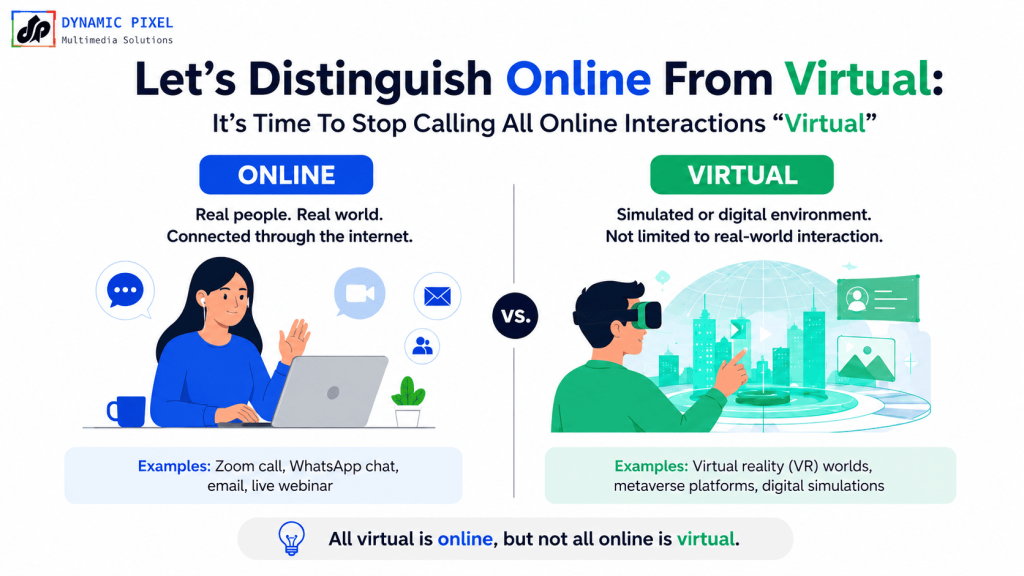
Virtual means something simulated or not physically real — it does not inherently mean “online.” A thing can be virtual without being online (a standalone VR simulation running on a local device with no internet) and online without being virtual (a video call between two real people). The word “virtual” became loosely associated with “online” through tech marketing and remote-work culture, but technically, they describe two different things: online is about how something happens (over the internet), while virtual is about what something is (simulated vs. real).
Is Virtual Online or Offline?
This is the question most people are actually asking, so let’s answer it directly: virtual isn’t inherently online or offline — it can be either.
“Virtual” describes something that is simulated, digitally created, or not physically real. Most virtual things today happen to be accessed online (a virtual assistant, a virtual world), which is why the two words get tangled together. But the internet isn’t what makes something virtual — the simulation is.
A virtual reality game running entirely on a standalone headset, with no internet connection at all, is still virtual — it’s a simulated environment, just an offline one. Meanwhile, a Zoom call between two real colleagues is online, but nothing about it is virtual — no part of it is simulated.
In short: “online” tells you the thing is connected to the internet. “Virtual” tells you the thing isn’t physically real. They can overlap, but they’re not the same question.
What Does Virtual Mean? The Actual Definition
The word “virtual” comes from the Latin virtus (strength or power), but its modern meaning has shifted: it now describes something that appears to exist or function as the real thing, without actually being physically real.
Examples of genuinely virtual things:
- A virtual reality game — you’re inside a fully simulated world that doesn’t physically exist.
- A virtual assistant (Alexa, Siri, Google Assistant) — software imitating a personal assistant; not a real person.
- A virtual machine — a computer created entirely by software inside another computer, not real hardware.
- A virtual pet or avatar — pixels representing something, not a real, physical entity.
What Does “Online” Mean?
Online simply means connected to or happening over the internet. It says nothing about whether something is real or simulated.
- Email is online — and completely real.
- A video call is online — and the people on it are completely real.
- Online banking is online — your real money, accessed digitally.
Online vs. Virtual: The Key Difference
| Online | Virtual | |
|---|---|---|
| What it describes | How something happens (via the internet) | What something is (simulated, not physically real) |
| Requires internet? | Yes, by definition | Not necessarily |
| Can involve real people/things? | Yes, always | No — by definition, virtual things aren’t physically real |
| Example | Online banking, email, a Zoom call | VR game, virtual assistant, virtual machine |
The simplest way to remember it: All virtual things are usually experienced through digital/online means, but not everything online is virtual. A phone call over the internet is online — the person on the other end is real, not simulated, so it isn’t virtual.
Why Do People Say “Virtual Meeting” Instead of “Online Meeting”?
If a Zoom call isn’t technically virtual, why does everyone call it a “virtual meeting”? A few real reasons:
- Tech and marketing language — companies like Microsoft and Zoom popularized “virtual meeting” and “virtual conference” as a modern-sounding label for online video calls, even though nothing about them is simulated.
- The remote-work shift — during the pandemic, “virtual work” became shorthand for “working online,” and the phrase stuck.
- It’s just easier to say — “virtual” became a convenient catch-all word for “anything digital,” even when a more accurate word (online, remote, digital) would fit better.
So the confusion isn’t really your fault — common usage bent the meaning of “virtual” over time, even though the technical definition hasn’t changed.
Quick Reference: When to Use Which Word
Use “online” when:
- Something happens over the internet
- Real people are interacting through a digital tool
- Content or services are accessed via the web
Examples: online shopping, online meeting, online banking, online course
Use “virtual” when:
- Something is simulated or not physically real
- Technology is creating an experience that mimics reality
- Nothing physical actually exists behind what you’re seeing
Examples: virtual reality, virtual assistant, virtual machine, virtual pet
Real-World Examples
| Situation | Online? | Virtual? | Why |
|---|---|---|---|
| Zoom call with colleagues | Yes | No | Real people, nothing simulated |
| VR headset game | Sometimes | Yes | Fully simulated world |
| AI customer service chatbot | Yes | Yes | Uses internet + isn’t a real person |
| Reading a blog post | Yes | No | Real content, real author |
| Standalone VR training (no internet) | No | Yes | Simulated, but not connected online |
FAQs
Q1. What does virtual mean?
Virtual means something that is simulated, digitally created, or not physically real, even though it may appear or function like the real thing. Examples include virtual reality, virtual assistants, and virtual machines.
Q2. Is virtual the same as online?
No. “Online” means connected to the internet, while “virtual” means simulated or not physically real. Something can be online without being virtual (a video call between real people) or virtual without being online (an offline VR simulation).
Q3. Is virtual online or offline?
Virtual can be either. The word describes whether something is simulated, not whether it requires an internet connection. A standalone VR experience with no internet is still virtual; an online video call between real people is not virtual at all.
Q4. Does virtual mean online?
Not technically. “Virtual” and “online” are often used interchangeably in casual speech — especially for things like “virtual meetings” — but they describe different concepts. Online refers to internet connectivity; virtual refers to simulation.
Q5. Why do people call online meetings “virtual meetings”?
This usage became common through tech marketing and the shift to remote work, where “virtual” was used as a catch-all term for anything digital. Technically, an online meeting between real people isn’t virtual, since nothing about it is simulated.
Q6. What is an example of something that is both online and virtual?
A multiplayer video game is a good example — it’s online (connected via the internet) and virtual (the entire game world is simulated and doesn’t physically exist).
Conclusion
“Online” and “virtual” get used interchangeably so often that most people never stop to ask if they actually mean the same thing — they don’t. Online is about connection (are you using the internet?). Virtual is about reality (is this thing actually real, or simulated?). Once you know the difference, you’ll notice how often “virtual” gets used loosely — and you’ll know exactly what someone means when they use it correctly.
Looking to build genuinely virtual training experiences — simulations, VR modules, or interactive e-learning? Dynamic Pixel creates custom digital learning content, from online courses to fully simulated virtual training environments.