
What Is a Virtual Learning Environment?
A Virtual Learning Environment (VLE) is a web-based digital platform that enables educators and students to interact, share content, manage coursework, and track learning progress — all in one centralized online space. Think of idt as a complete digital campus that never closes.
In 2026, VLEs are the backbone of modern education — powering schools, universities, and corporate training programs worldwide. Whether you call it a VLE, an LMS, or an e-learning platform, the mission is the same: make quality education accessible to anyone, anywhere, at any time.
Why VLEs Are Redefining Education in 2026
The way the world learns has fundamentally changed. Walking into a classroom is no longer the only — or even the preferred — path to quality education. Virtual Learning Environments have evolved from emergency pandemic tools into essential infrastructure for institutions and businesses globally.
The numbers make this undeniable:
The global e-learning market is projected to exceed $375 billion by 2026 (Statista, April 2026)
The LMS market alone is valued at approximately $26.8 billion in 2025 (IMARC Group)
Online learning has expanded by 900% globally since 2000 — the fastest-growing segment in education
73.8 million people currently rely on LMS/VLE platforms worldwide
60% of online learners report improved critical thinking skills through digital learning (BAU, 2025)
Behind all of this growth sits one core technology: the Virtual Learning Environment.
What Is a VLE? — Full Definition
A Virtual Learning Environment — commonly abbreviated as VLE — is an integrated digital ecosystem that supports the delivery, management, and tracking of educational content alongside learner-instructor interaction, all accessible online.
Unlike a simple website or a file-sharing folder, a VLE is an active, living educational space. It provides:
- Course content delivery: videos, readings, slides, podcasts, and interactive modules
- Communication tools: forums, live chat, discussion boards, and video conferencing
- Assessment tools: quizzes, assignments, exams, and peer reviews
- Progress tracking: grades, analytics, dashboards, and completion reports
- Collaboration spaces: group projects, wikis, shared documents, and study groups
Key Definition: A VLE is a platform or collection of integrated digital tools used to manage online learning, enabling educators and students to transmit, receive, and share knowledge at a distance — both asynchronously and in real-time. (EBSCO Research, 2025)
VLE vs. LMS vs. OLE: What Is the Difference?
Many terms are used interchangeably, but there are meaningful distinctions worth knowing:
| Feature | VLE | LMS | OLE (Online Learning Env.) |
| Primary Focus | Teaching & learning interaction | Course delivery & management | Broad digital content access |
| Structure | Guided, instructor-led pathways | Structured course framework | Flexible, self-paced |
| Interaction Level | High (sync + async) | Moderate | Lower (content-centric) |
| Best For | Schools & Universities | Corporate training | Independent learners |
| Examples | Moodle, Blackboard, Canvas | TalentLMS, Docebo | Coursera, Udemy |
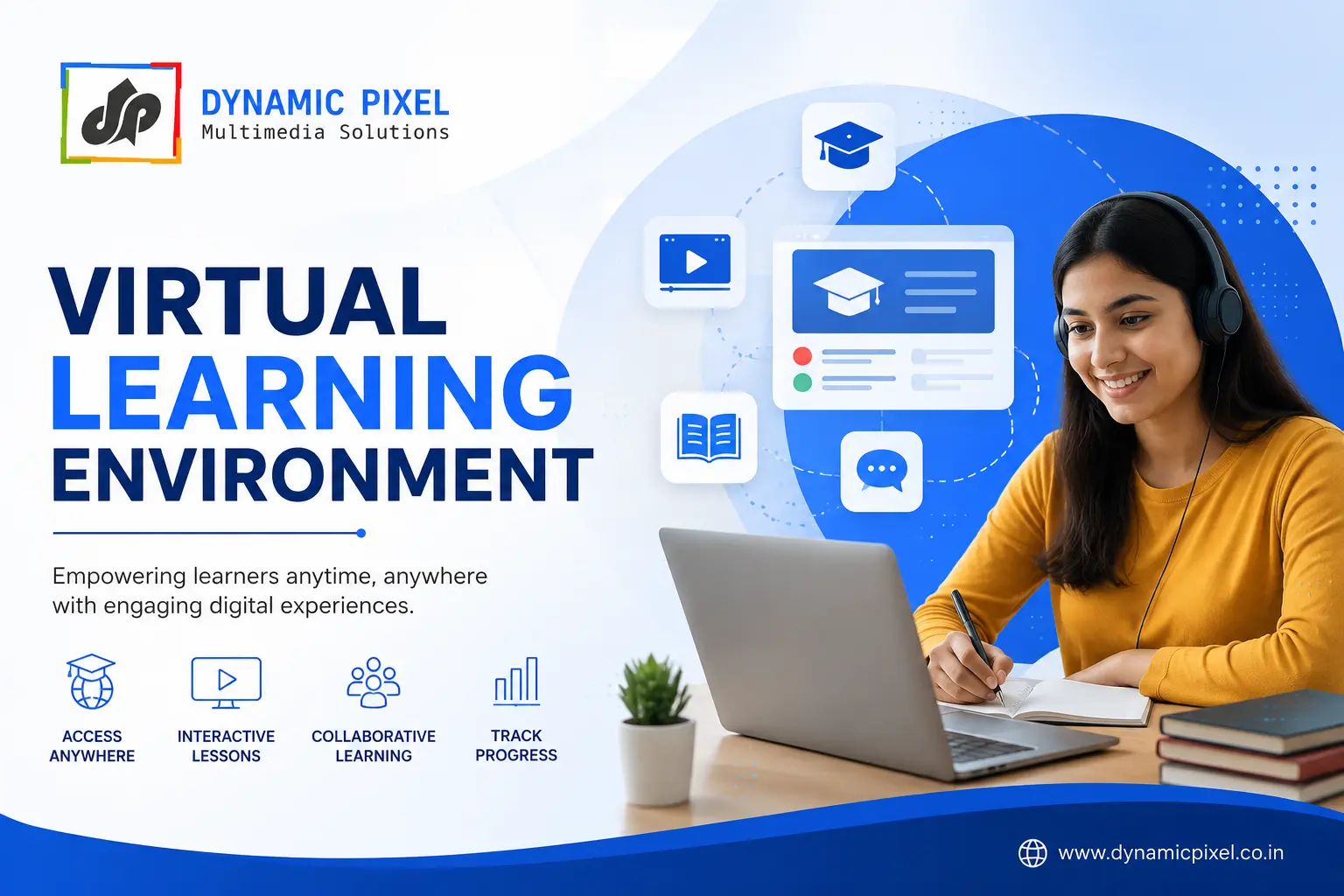
What Is Included in a Virtual Learning Environment?
A well-built VLE is far more than a content library. Modern platforms in 2026 include a rich suite of features:
1. Content Management System (CMS)
Upload, organize, and deliver lectures, PDFs, videos, and interactive modules within a structured, sequential learning pathway that guides learners from start to finish.
2. Communication & Collaboration Tools
Discussion forums, live chat, video conferencing integrations (Zoom, Microsoft Teams, Google Meet), and peer-to-peer messaging keep learners and educators connected regardless of time zone.
3. Assessment & Testing Tools
Quizzes, assignment submission portals, automated grading, rubrics, and plagiarism detection make evaluation faster and more objective — saving educators hours every week.
4. Progress Tracking & Analytics
Real-time dashboards for both students and educators display course completion rates, engagement levels, time-on-task, quiz scores, and performance trends across cohorts.
5. Calendar & Scheduling
Event reminders, deadline notifications, live session links, and syllabus timelines ensure no one misses a critical milestone.
6. Resource Library
A centralized repository for supplementary materials, past papers, recorded lectures, glossaries, and curated external links — all searchable and organized by topic.
7. Gamification & Engagement Features
Badges, leaderboards, XP points, streak tracking, and digital certificates motivate learners and dramatically improve course completion rates.
8. AI-Powered Personalization (2025–2026 Frontier)
Adaptive learning algorithms now adjust content difficulty and delivery sequence based on individual learner performance — one of the most transformative VLE developments of 2026.
Types of Virtual Learning Environments
1. Synchronous VLEs
Real-time learning where students and instructors interact live — via video conferencing, live classes, or real-time collaborative tools. Best for discussions, debates, and immediate feedback sessions.
2. Asynchronous VLEs
Learners access content at their own pace — through recorded lectures, self-paced quizzes, and threaded forum discussions. Ideal for global learners spanning multiple time zones.
3. Blended / Hybrid VLEs
The dominant model in 2026 — combining in-person instruction with digital VLE tools. Students attend some sessions physically while accessing coursework and assessments online. This model delivers the best of both worlds.
4. Immersive VLEs (AR/VR)
The fastest-growing category. VR-based learning environments simulate real-world scenarios — from medical procedures and engineering labs to historical recreations. The VR e-learning market hit $9.51 billion in 2026, growing at a 22.3% CAGR (Global Market Report, March 2026).
Top Virtual Learning Environment Platforms in 2026
| Platform | Best For | Key Feature | Pricing |
| Moodle | Universities & Schools | Open-source, highly customizable | Free (self-hosted) |
| Canvas (Instructure) | Higher Education | Intuitive UI, rich integrations | Paid |
| Blackboard Ultra | Enterprise Education | Robust analytics, AI tools | Paid |
| Google Classroom | K-12 Schools | Google Workspace integration | Free |
| MS Teams Education | K-12 & Higher Ed | Office 365, seamless collaboration | Free/Paid |
| TalentLMS | Corporate Training | Fast setup, gamification | Paid |
| D2L Brightspace | K-12 to University | Adaptive learning, accessibility | Paid |
Benefits of Using a Virtual Learning Environment
For Students
- Learn anytime, anywhere: no geographical or time constraints
- Self-paced options: accommodate different learning styles and speeds
- Instant access: notes, videos, and quizzes available 24/7
- Real-time feedback: on assignments and assessments
- Cost savings: reduced commuting, accommodation, and printing costs
For Educators
- Automated grading: save hours each week on repetitive tasks
- Data-driven insights: identify struggling students early with performance analytics
- Easy content updates: edit materials instantly without reprinting
- Scalability: teach hundreds or thousands simultaneously
- Global reach: break geographic barriers and grow your audience
For Institutions & Organizations
- Reduced operational costs: maintaining physical classrooms and printed materials
- Compliance tracking: essential for regulated industries and corporate training
- Centralized data management: all student records in one secure platform
- Improved enrollment rates: through flexible, accessible delivery models
VLEs in 2026: The AI Revolution
The single most significant development reshaping virtual learning environments right now is the deep integration of Artificial Intelligence. Here is what is actively changing in 2025–2026:
- AI Tutors & Chatbots: Platforms now embed AI assistants that answer student queries 24/7, reducing dependency on instructor availability outside class hours.
- Adaptive Learning Algorithms: AI analyzes individual performance to personalize content — harder challenges for advanced learners, revision modules for those falling behind.
- Automated Content Creation: Educators use AI tools within VLEs to generate quizzes, flashcards, and learning modules directly from uploaded materials.
- Predictive Analytics: AI flags at-risk students before they drop out, enabling early intervention and support.
- Natural Language Processing: Voice-enabled learning and real-time transcription make VLEs more accessible to learners with disabilities or language barriers.
April 2025 Update: zSpace, Inc. launched a new immersive VR education platform, advancing hands-on STEM learning through virtual environments — signaling where VLEs are headed next.
How to Choose the Right VLE: A 7-Step Framework
- Define your audience — K-12, higher education, or corporate learners?
- Identify your content types — video-heavy, text-based, or interactive simulations?
- Check integration needs — Zoom, Google Workspace, Microsoft 365, SCORM compliance?
- Evaluate scalability — are you serving 50 users today or planning for 50,000 tomorrow?
- Assess support and uptime guarantees — critical during peak exam seasons
- Compare total cost of ownership — setup fees, hosting, licenses, and ongoing support
- Test mobile responsiveness — over 43% of learners access education primarily via mobile devices
Key Takeaways
A Virtual Learning Environment (VLE) is the backbone of modern digital education — a centralized, interactive, and data-driven platform where teaching and learning converge online.
- VLEs integrate content management, communication, assessments, analytics, and AI personalization
- The global e-learning market exceeds $375 billion by 2026, growing at a 9.1% CAGR
- AI integration — adaptive learning, chatbots, predictive analytics — is the defining VLE trend of 2025–2026
- Top platforms include Moodle, Canvas, Blackboard, D2L Brightspace, and Google Classroom
- VLEs serve K-12 schools, universities, and enterprises — cutting costs while improving learning outcomes
- Blended learning remains the dominant VLE delivery model in 2026
Frequently Asked Questions (FAQ)
Q1: What is a Virtual Learning Environment (VLE)?
A VLE is a web-based digital platform that integrates educational content, communication tools, assessments, and analytics in one online space. It enables instructors and learners to engage in structured education regardless of physical location — accessible 24/7 from any device.
Q2: What does VLE mean?
VLE stands for Virtual Learning Environment. It refers to an online educational ecosystem where teaching, learning, assessment, and collaboration occur digitally through an integrated set of tools — replacing or supplementing the traditional physical classroom.
Q3: What is included in a virtual learning environment?
A modern VLE typically includes a content management system, discussion forums, live video tools, quizzes and assessments, grade tracking, analytics dashboards, a course calendar, resource libraries, gamification features, and AI-powered personalization capabilities.
Q4: What is the difference between a VLE and an LMS?
A VLE emphasizes the interactive educational experience — the ‘environment’ for learning. An LMS (Learning Management System) focuses on the administrative delivery and tracking of courses. In practice, most modern platforms combine both functions, making the distinction largely semantic in 2026.
Q5: What are examples of virtual learning environments?
Popular VLE platforms include Moodle (open-source), Canvas by Instructure, Blackboard Ultra, D2L Brightspace, Google Classroom, and Microsoft Teams for Education. Each serves different institution sizes and use cases.
Q6: How does a VLE support different learning styles?
VLEs cater to visual learners (videos, infographics), auditory learners (podcasts, recorded lectures), reading/writing learners (notes, forums), and kinesthetic learners (simulations, gamified interactive tasks) — all within a single, unified platform.
Q7: Are virtual learning environments only for schools and universities?
No. VLEs are widely deployed in corporate training, professional development, government agencies, healthcare, and non-profits. Enterprise platforms such as TalentLMS, Docebo, and SAP SuccessFactors Learning are built specifically for workplace learning environments.
Q8: Can VLEs support both synchronous and asynchronous learning?
Yes. Modern VLEs support both modes. Synchronous features include live video sessions and real-time chat. Asynchronous features include recorded lectures, threaded discussion boards, and self-paced modules — giving learners maximum flexibility.
Q9: How is AI changing virtual learning environments in 2026?
AI is enabling 24/7 tutoring chatbots, adaptive learning paths, automated assessment generation, predictive at-risk analytics, and AI-powered content creation tools — making VLEs smarter, more responsive, and more personalized than ever before.
Q10: Is a VLE different from a virtual classroom?
Yes. A virtual classroom replicates a live, synchronous physical class online. A VLE is a much broader ecosystem — encompassing asynchronous content, assessments, analytics, long-term course management, and learner records — extending far beyond any single live session.
