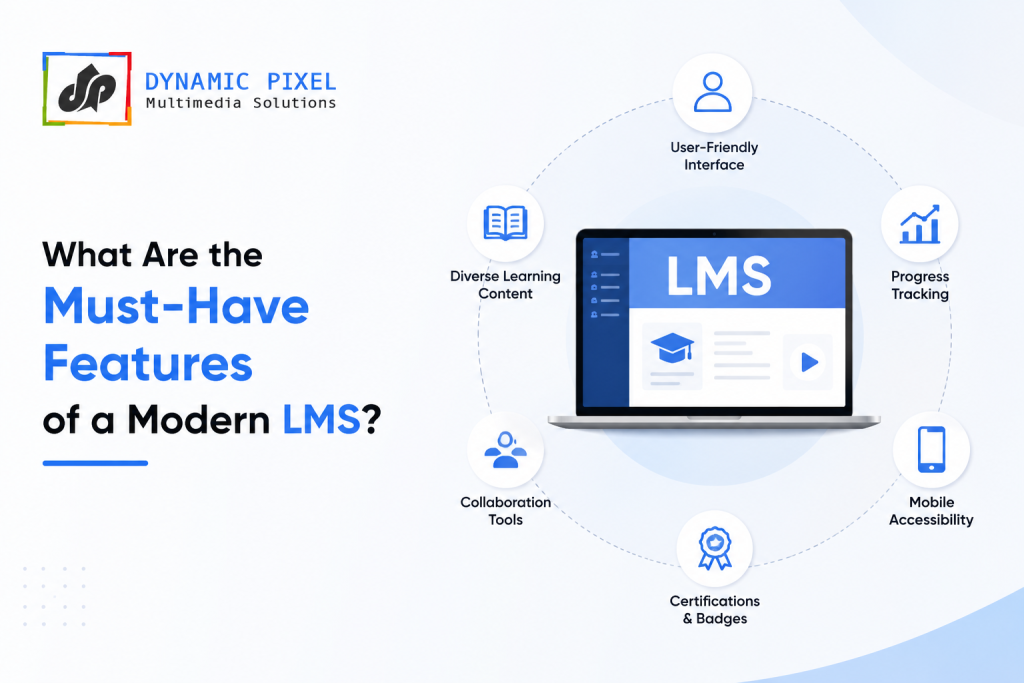
A modern Learning Management System needs AI-powered personalization, gamification and engagement tools, mobile-first delivery, SCORM/xAPI compliance, robust analytics and reporting, seamless integrations, custom branding, and strong data security. Platforms missing even two or three of these fall behind fast — especially as the global LMS market grows from USD 28.6 billion in 2025 to a projected USD 123.8 billion by 2033 (Grand View Research), driven almost entirely by demand for smarter, more flexible corporate training tools.
Introduction
If you’re evaluating a Learning Management System Features checklist for your organization in 2026, one thing is clear: the bar has moved. The clunky, static course-upload tools that defined corporate training a decade ago simply can’t keep up with how people actually want to learn today — on their phones, in short bursts, with content that adapts to them instead of the other way around.
So, what are the must-have features of a modern LMS? This guide breaks it down feature by feature, backed by current data, so you can evaluate any platform — including your current one — against a genuinely 2026-ready standard.
Why Modern LMS Features Matter More Than Ever
The numbers make the case better than any sales pitch could:
| Metric | Data Point |
|---|---|
| Global LMS market size (2025) | USD 28.6 billion |
| Projected LMS market size (2033) | USD 123.8 billion (20.2% CAGR) |
| Corporate LMS segment growth rate | 22.5–23.8% CAGR — faster than the overall market |
| LMS platforms with AI integration (2025) | Only ~22% |
| Mobile learning productivity boost | 43% higher productivity vs. desktop-only training |
| Mobile learning retention improvement | 45% better retention vs. desktop-only training |
| Employees who say training improves job performance | 59% |
| Employees who would stay longer with employers investing in training | ~80% |
Two things stand out here. First, corporate training is growing faster than the LMS market overall — companies are spending more, expecting more. Second, only about 22% of LMS platforms currently have real AI integration, which means most organizations are still using tools that are already behind the curve. That gap is exactly where the “must-have” features below make the difference between a platform that gets used and one that quietly gathers dust.
Modern LMS vs. Traditional LMS: A Side-by-Side Comparison
| Feature | Traditional LMS | Modern LMS (2026 Standard) |
|---|---|---|
| Content delivery | Static, one-size-fits-all courses | AI-personalized learning paths |
| Device support | Desktop-only or poorly optimized mobile | True mobile-first, offline-capable |
| Engagement tools | Minimal — text and quizzes only | Gamification, badges, leaderboards |
| Reporting | Basic completion tracking | Real-time analytics & predictive insights |
| Content standards | Limited or no SCORM support | Full SCORM/xAPI compliance |
| Branding | Generic, vendor-branded interface | Fully white-labeled, custom branding |
| Integrations | Isolated, standalone system | Connects with HRMS, Slack, Teams, CRM |
| Security | Basic login protection | Role-based access, data encryption, compliance-ready |
If your current platform sits mostly in the left column, it’s not a modern LMS — regardless of what the vendor calls it.
The Must-Have LMS Features Checklist
1. AI-Powered Personalization
An AI-Powered LMS doesn’t just deliver content — it adapts to the learner. Based on performance, pace, and role, AI can recommend the next course, flag knowledge gaps, and adjust difficulty automatically. This single feature is arguably what separates a genuinely modern platform from a digitized version of a training binder.
2. Mobile-First, Responsive Learning
With mobile learning boosting productivity by 43% and retention by 45% compared to desktop-only training, mobile compatibility isn’t optional anymore — it’s foundational. Employees expect to train during a commute or between meetings, not just at a desk.
3. Gamification and Engagement Tools
Badges, leaderboards, points, and progress streaks aren’t gimmicks — they directly address one of L&D’s biggest problems: less than 30% of employees are satisfied with their career-growth learning opportunities. Gamification measurably improves completion rates and sustained engagement, especially for compliance and soft-skills training that otherwise feels like a chore.
4. SCORM and xAPI Compliance
For any organization managing multiple course vendors or needing to migrate content between systems, SCORM (and increasingly xAPI) compliance is essential. Without it, you risk vendor lock-in and lost training data if you ever switch platforms.
5. Robust Analytics and Reporting
A modern LMS should tell you not just who completed a course, but how well they understood it, where they struggled, and what to do next. Real-time dashboards and exportable reports are essential for L&D teams that need to demonstrate ROI to leadership.
6. Seamless Third-Party Integrations
Your LMS shouldn’t be an island. Integration with HR systems, Slack, Microsoft Teams, and video conferencing tools reduces admin overhead and keeps training embedded in employees’ actual workflow, rather than a separate destination they have to remember to visit.
7. Custom Branding and White-Labeling
For businesses offering training as part of their own brand experience — or simply wanting a professional, consistent look — custom login pages, logos, and menu structures matter more than most buyers initially realize. A generic, vendor-branded LMS interface undercuts trust before the first course even loads.
8. Scalable User and Role Management
As organizations grow, an LMS needs to support department-level structuring, bulk user uploads, and role-based permissions (admin, manager, learner) without becoming an administrative headache. This is one of the most overlooked Corporate LMS Features until a company scales past a few hundred users and suddenly feels the pain.
9. Strong Data Security and Compliance
With training data increasingly tied to HR records and compliance certifications, encryption, role-based access control, and audit trails aren’t nice-to-haves — they’re a baseline requirement, especially for regulated industries.
10. Microlearning and Bite-Sized Content Support
The corporate microlearning market is projected to reach roughly $5.5 billion by 2030. A modern LMS should natively support short, focused modules — not force every course into a rigid, hour-long format that few employees actually finish.
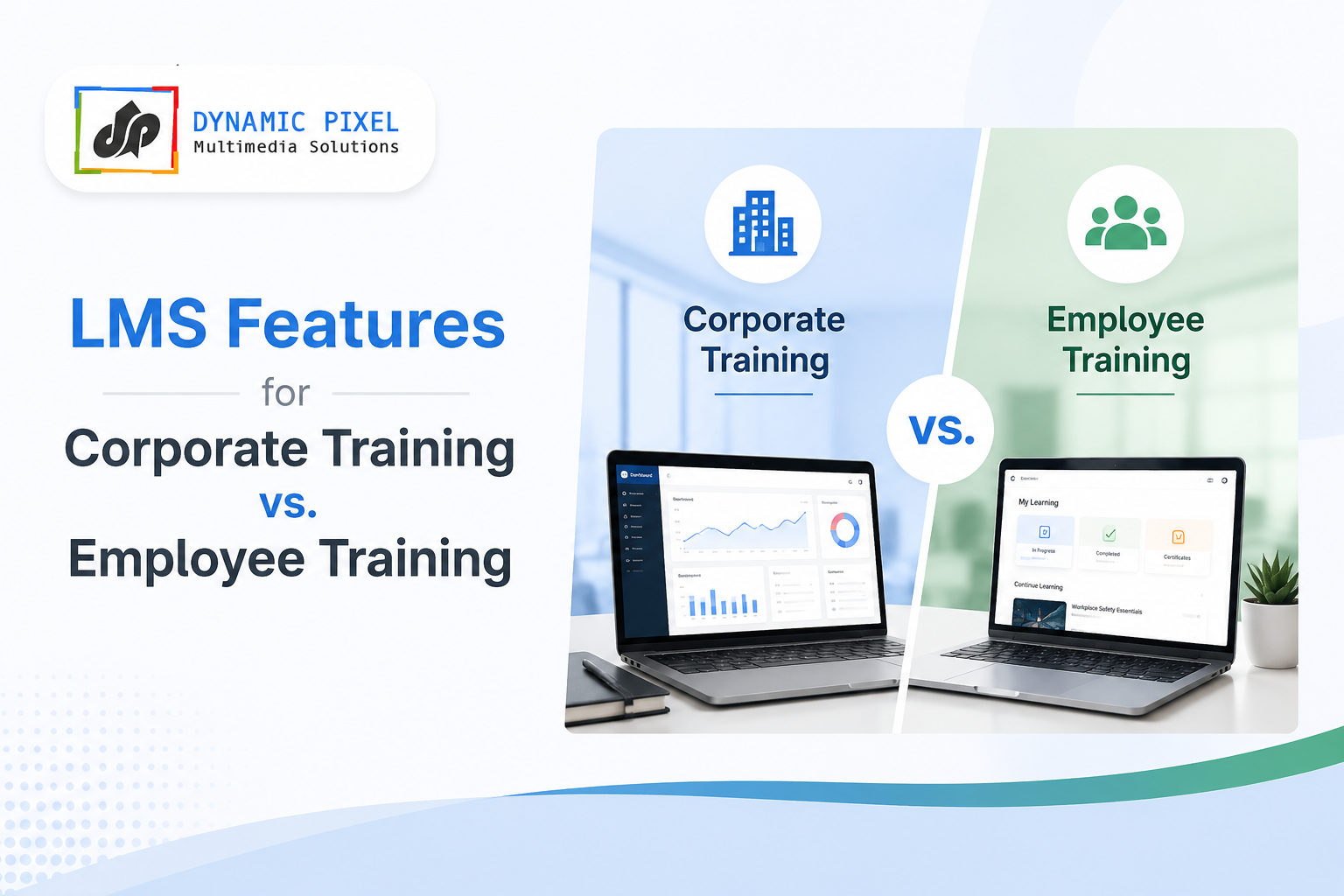
Best LMS Features for Corporate Training vs. Employee Training LMS Needs
While the two overlap significantly, the priorities can differ slightly:
| Priority | Corporate LMS Focus | Employee Training LMS Focus |
|---|---|---|
| Primary goal | Organization-wide skill alignment, compliance | Individual skill-building, onboarding, retention |
| Key feature | Advanced reporting for leadership visibility | Personalized learning paths & gamification |
| Content style | Structured, role-based curricula | Bite-sized, self-paced microlearning |
| Success metric | Business KPIs, compliance rates | Completion rates, engagement, satisfaction |
A genuinely modern LMS platform should serve both needs from the same system, rather than forcing you to choose.
How Dynamic Pixel Delivers on These Must-Have Features
At Dynamic Pixel, we’ve spent over a decade building custom eLearning content and Learning Management Systems for organizations that need more than a generic course catalog. Our approach directly addresses the gaps outlined above:
- Our AI-powered LMS ships with 100+ ready-to-use, gamified courses across 14+ categories — so you’re not starting from zero.
- Fully customizable branding — your logo, your login page, your organizational structure, not a vendor’s.
- SCORM-compliant content development, built for compatibility with your existing systems if you already have an LMS in place.
- Detailed reporting covering course completions, login activity, and license usage, so L&D teams can prove ROI with real data.
- Role-based access (Manager, User, Course Educator) built in from day one, supporting organizations from small teams to large enterprises.
If your current platform is missing more than two or three of the must-have features covered in this guide, it may be time for a conversation — not a full rebuild, necessarily, but at least an honest audit of where the gaps are costing you engagement and results.
Frequently Asked Questions
Q1. What is a modern LMS?
A modern LMS is a learning management platform built around AI personalization, mobile-first delivery, gamification, and real-time analytics — designed to adapt to learners rather than deliver static, one-size-fits-all content.
Q2. What features should an LMS have?
At minimum: AI-powered personalization, mobile responsiveness, gamification, SCORM/xAPI compliance, robust analytics, third-party integrations, custom branding, and strong data security.
Q3. Which LMS features are most important?
AI personalization and mobile-first design are widely considered the most impactful, since they directly affect engagement and retention — two of the biggest challenges L&D teams report today.
Q4. What makes a good learning management system?
A good LMS combines strong content delivery with measurable outcomes — it should be easy for learners to use, easy for admins to manage, and capable of showing clear data on what’s working and what isn’t.
Q5. What are the core LMS features?
The core features are content management, user/role management, reporting and analytics, mobile access, and integration capability — with AI personalization and gamification increasingly considered core rather than optional in 2026.
Conclusion: Choosing an LMS That Won’t Fall Behind
The gap between a “good enough” LMS and a genuinely modern one is only going to widen as AI adoption accelerates — remember, just 22% of platforms have real AI integration today, which means the other 78% are already playing catch-up. Whether you’re selecting a new platform or auditing your current one, use the checklist in this guide as your baseline, not your ceiling.
If you’d like a platform that already checks these boxes — rather than a roadmap promising to get there — talk to the Dynamic Pixel team about our AI-powered LMS or a custom eLearning solution built around your organization’s specific needs.
Call: 0120-4119119
Email: info@dynamicpixel.co.in
Explore: dynamicpixel.co.in